18 Results for "

MDMA

" in MedChemExpress (MCE) Product Catalog:
Products (18)

18 Results for "MDMA" in MCE Product Catalog:

55
55 Publications Verification
Cat. No.: HY-B0764
CAS No.: 16980-89-5
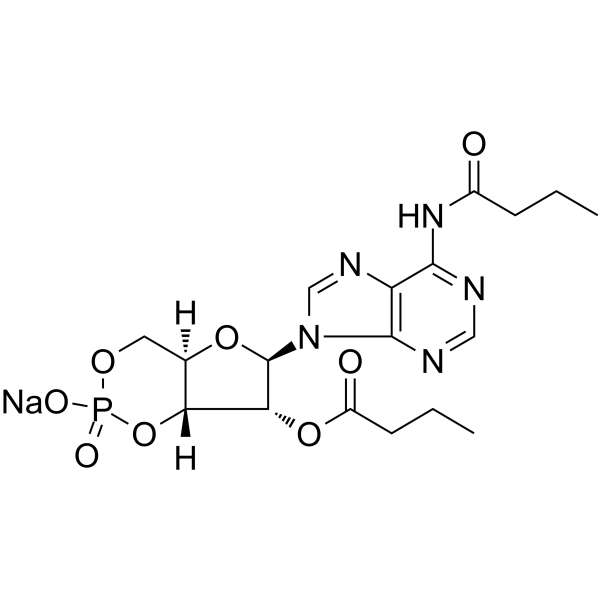
Synonyms: Dibutyryl cAMP sodium; DBcAMP sodium
Bucladesine (Dibutyryl cAMP; DBcAMP) sodium is a membrane-permeable 3′, 5′-cyclic adenosine monophosphate (cAMP) analog. Bucladesine selectively activates cAMP dependent protein kinase (PKA) by increasing the intracellular level of cAMP. Bucladesine significantly attenuates MDMA-induced increases in hippocampal mitochondrial ROS formation, mitochondrial outer membrane damage, cytochrome c release, and hippocampal ADP/ATP ratio, thereby improving spatial learning and memory impairments. Bucladesine exhibit anti-nociceptive and anti-inflammation effect. Bucladesine can inhibit cancer cells proliferation, induce apoptosis. Bucladesine can be used for the researches of neurological disease, cancer, inflammation .
loading...
    loading...
55
55 Publications Verification
Cat. No.: HY-B0764A
CAS No.: 938448-87-4
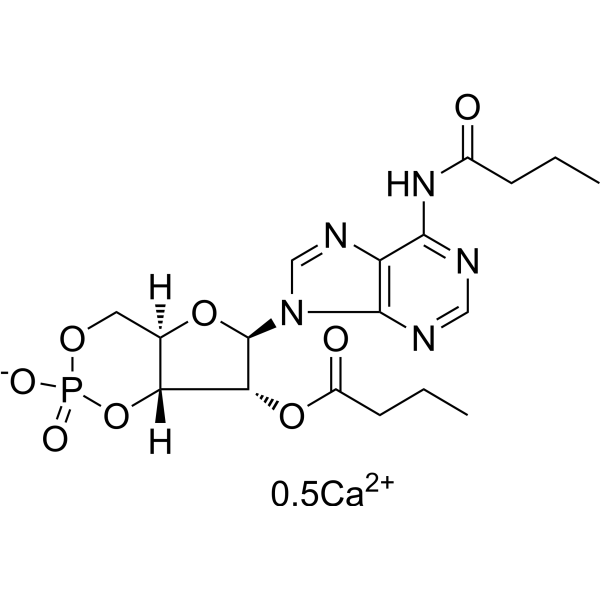
Synonyms: Dibutyryl cAMP hemicalcium; DBcAMP hemicalcium
Bucladesine (Dibutyryl cAMP; DBcAMP) hemicalcium is a membrane-permeable 3′, 5′-cyclic adenosine monophosphate (cAMP) analog. Bucladesine selectively activates cAMP dependent protein kinase (PKA) by increasing the intracellular level of cAMP. Bucladesine significantly attenuates MDMA-induced increases in hippocampal mitochondrial ROS formation, mitochondrial outer membrane damage, cytochrome c release, and hippocampal ADP/ATP ratio, thereby improving spatial learning and memory impairments. Bucladesine exhibit anti-nociceptive and anti-inflammation effect. Bucladesine can inhibit cancer cells proliferation, induce apoptosis. Bucladesine can be used for the researches of neurological disease, cancer, inflammation .
loading...
    loading...
Cat. No.: HY-B0764B
CAS No.: 362-74-3
Synonyms: Dibutyryl cAMP; DBcAMP
Bucladesine (Dibutyryl cAMP; DBcAMP) is a membrane-permeable 3′, 5′-cyclic adenosine monophosphate (cAMP) analog. Bucladesine selectively activates cAMP dependent protein kinase (PKA) by increasing the intracellular level of cAMP. Bucladesine significantly attenuates MDMA-induced increases in hippocampal mitochondrial ROS formation, mitochondrial outer membrane damage, cytochrome c release, and hippocampal ADP/ATP ratio, thereby improving spatial learning and memory impairments. Bucladesine exhibit anti-nociceptive and anti-inflammation effect. Bucladesine can inhibit cancer cells proliferation, induce apoptosis. Bucladesine can be used for the researches of neurological disease, cancer, inflammation .
loading...
    loading...
Cat. No.: HY-W012426
CAS No.: 32231-06-4
Synonyms: MDBP
Research Areas:  

Neurological Disease

1-Piperonylpiperazine (MDBP) is metabolized by demethylenation and subsequent methylation to N-(4-hydroxy-3-methoxybenzyl)piperazine followedby partial glucuronidation or sulfation. 1-Piperonylpiperazine can alter the disposition and metabolism of 3,4-methylenedioxymethamphetamine (MDMA) in the brain and in peripheral organs. 1-Piperonylpiperazine can inhibit the MDMA-induced neurotoxicity .
loading...
    loading...
Cat. No.: HY-B0764R
CAS No.: 16980-89-5
Synonyms: Dibutyryl cAMP sodium (Standard); DBcAMP sodium (Standard)
Bucladesine (Dibutyryl cAMP; DBcAMP) sodium (Standard) is the analytical standard of Bucladesine sodiumn (HY-B0764). This product is intended for research and analytical applications. Bucladesine is a membrane-permeable 3′, 5′-cyclic adenosine monophosphate (cAMP) analog. Bucladesine selectively activates cAMP dependent protein kinase (PKA) by increasing the intracellular level of cAMP. Bucladesine significantly attenuates MDMA-induced increases in hippocampal mitochondrial ROS formation, mitochondrial outer membrane damage, cytochrome c release, and hippocampal ADP/ATP ratio, thereby improving spatial learning and memory impairments. Bucladesine exhibit anti-nociceptive and anti-inflammation effect. Bucladesine can inhibit cancer cells proliferation, induce apoptosis. Bucladesine can be used for the researches of neurological disease, cancer, inflammation .
loading...
    loading...
Cat. No.: HY-172346
Synonyms: N-OH MDMA hemioxalate; FLEA hemioxalate
Target:  

Drug Derivative

N-Hydroxy MDMA (N-OH MDMA) hemioxalate is an N-hydroxy analogue of 3,4-methylenedioxymethamphetamine (MDMA). N-Hydroxy MDMA hemioxalate can be rapidly metabolized to MDMA and MDA in rats, which are mainly excreted in urine, and can also be detected in hair .
loading...
    loading...
Cat. No.: HY-W725213
CAS No.: 54690-19-6
Synonyms: BL-3912; alpha-EH DOM
Research Areas:  

Others

α-ethyl 2C-D (BL-3912) hydrochloride is a phenethylamine and amphetamine compound. In drug discrimination studies, α-ethyl 2C-D hydrochloride can serve as a reference standard for MDMA .
loading...
    loading...
Cat. No.: HY-W506356
CAS No.: 168968-01-2
Target:  

Adrenergic Receptor

Research Areas:  

Neurological Disease

2,3-MDMA hydrochloride is a noradrenalin transporter and serotonin transporter inhibitor with IC50 values of 6.2 μM and 82 μM, respectively .
loading...
    loading...
Cat. No.: HY-139265
CAS No.: 1228259-70-8
Target:  

Drug Derivative

Research Areas:  

Neurological Disease

3,4-MDMA tert-butyl carbamate is a psychoactive compound.
loading...
    loading...
Cat. No.: HY-W106785
CAS No.: 16350-96-2
Target:  

Drug Derivative

Research Areas:  

Others

N-Benzylcyclohexylamine hydrochloride, an arylcyclohexylamine, is a cutting agent in 3,4-MDMA samples.
loading...
    loading...
Cat. No.: HY-158806
CAS No.: 2704135-58-8
Synonyms: 3,4-Dihydroxymethamphetamine TFA; N-Methyl-α-methyldopamine TFA; HHMA TFA
Target:  

Drug Derivative

Research Areas:  

Neurological Disease

3,4-DHMA (3,4-Dihydroxymethamphetamine) TFA is an active metabolite of 3,4-MDMA .
loading...
    loading...
Cat. No.: HY-116441
CAS No.: 13062-61-8
Target:  

Drug Metabolite

Research Areas:  

Neurological Disease

4-Hydroxy-3-methoxyamphetamine hydrochloride is a metabolite of 3,4-Methylenedioxymethamphetamine (MDMA). 4-Hydroxy-3-methoxyamphetamine hydrochloride can be used for forensic analysis .
loading...
    loading...
Cat. No.: HY-W701743
CAS No.: 828-06-8
Synonyms: α-Methyldopamine hydrochloride; α-MeDA hydrochloride
3,4-Dihydroxyamphetamine (α-Methyldopamine) (hydrochloride) is a secondary metabolite of 3,4-Methylenedioxymethamphetamine (MDMA). 3, 4-dihydroxyamphetamine (hydrochloride) is cytotoxic to rat hepatocytes. 3, 4-dihydroxyamphetamine (hydrochloride) is also used in the study of high blood pressure .
loading...
    loading...
Cat. No.: HY-W783844
CAS No.: 1207542-48-0
Target:  

Drug Isomer

Research Areas:  

Neurological Disease

(R)-Nantenine ((R)-(-)-nantenine) is the levorotatory isomer of Nantenine (HY-N9141). (R)-Nantenine has high affinity and selectivity for the α1A adrenergic receptor. (R)-Nantenine can block the behavioral suppression induced by MDMA. (R)-Nantenine is mainly used for the research related to diseases caused by MDMA abuse .
loading...
    loading...
Cat. No.: HY-172763
CAS No.: 2748304-41-6
EDMA hydrochloride is a derivative of MDMA. EDMA hydrochloride is a substrate for multiple neurotransmitter transporters, including serotonin transporter (SERT), dopamine transporter (DAT), and norepinephrine transporter (NET). EDMA hydrochloride has 5-HT releasing activity at SERT (EC50 = 117 nM) and MPP + releasing activity at DAT (EC50 = 597 nM) and NET (EC50 = 325 nM) .
loading...
    loading...
Cat. No.: HY-184086
CAS No.: 139953-73-4
Research Areas:  

Cancer

Cyclazosin is an α1D-adrenergic receptor antagonist and a partial agonist of CXCR4/ACKR3. The pKi values of Cyclazosin for cloned human α1D, α1B and α1A adrenergic receptors are 9.28, 9.23 and 8.18, respectively. Cyclazosin induces β-arrestin recruitment in CXCR4 and ACKR3 with EC50 values of 16 μM and 10 μM, respectively, stimulates ERK1/2 phosphorylation, and induces receptor internalization. Cyclazosin potently inhibits CXCL12-induced chemotaxis of primary human aortic vascular smooth muscle cells. Cyclazosin alters MDMA-induced thermoregulatory responses in mice, converting monophasic hyperthermia to a biphasic pattern without affecting resting core body temperature. Cyclazosin can be used for diseases related to tumor metastasis, MDMA-induced hyperthermia and vasoconstriction .
loading...
    loading...
Cat. No.: HY-W680886
CAS No.: 152623-93-3
6-APDB is a class of monoamine neurotransmitter releaser and Monoamine Transporter modulator that exerts selective effects on human monoamine transporters and acts as a partial agonist at 5-HT2 family receptors. For NET, 6-APDB has an IC50 of 0.56 μM and a Ki of 18 μM; for SERT, it has an IC50 of 2.3 μM and a Ki of 23 μM; for DAT, it has an IC50 of 33 μM and a Ki of >30 μM, and affinity for rat and mouse TAAR1, with Ki values of 1.0 μM and 0.21 μM, respectively. 6-APDB inhibits norepinephrine and 5-HT reuptake, mediates the release of three types of monoamine neurotransmitters, shows a dose-dependent biphasic locomotor effect in mice, and fully substitutes the discriminative stimulus effect of MDMA. 6-APDB shows no significant cytotoxicity at high concentrations, and possesses empathogenic psychoactivity, potential hallucinogenic effects, and behavioral effects associated with intermittent abuse .
loading...
    loading...
  • 1

