18 Results for "

PD-1 therapy

" in MedChemExpress (MCE) Product Catalog:
Products (18)

18 Results for "PD-1 therapy" in MCE Product Catalog:

3
3 Cited Publications
Cat. No.: HY-12964
CAS No.: 1239875-86-5
Purity:  99.32%
Target:  

TAM Receptor

Research Areas:  

Cancer

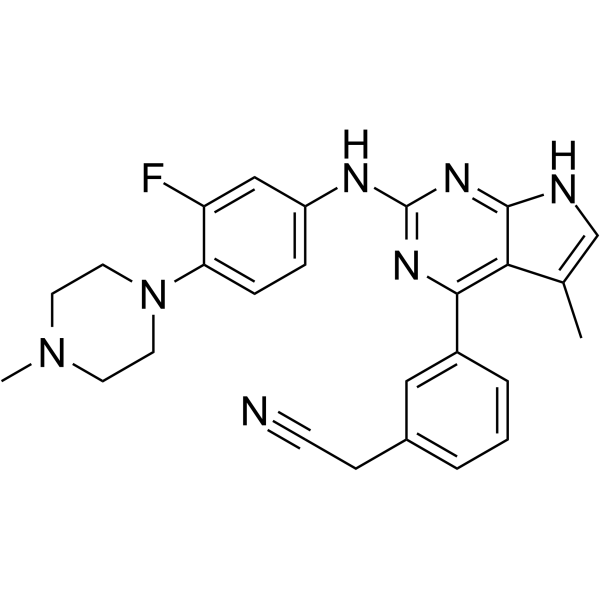
SGI-7079 is a selective, ATP-competitive, orally active inhibitor of the receptor tyrosine kinase Axl. SGI-7079 blocks Axl-mediated signaling pathways such as NF-κB activation and MMP-9 expression, thereby inhibiting tumor cell proliferation, migration and invasion. SGI-7079 is mainly used in the research of malignant tumors such as inflammatory breast cancer and bladder cancer, as well as in combination with immunization (used in combination with PD-1 therapy)[1][2][3].
loading...
    loading...
1
1 Cited Publications
Cat. No.: HY-P99144A

Target:  

PD-1/PD-L1

Research Areas:  

Inflammation/Immunology Cancer

Anti-Mouse PD-1 Antibody (S-5001) is a selective inhibitor targeting PD-1, blocking the PD-1/PD-L1 immune checkpoint axis through competitive binding to PD-1. Anti-Mouse PD-1 Antibody (S-5001) works by reversing the tumor immunosuppressive microenvironment and reactivating the anti-tumor activity of cytotoxic T lymphocytes. It can be used in research on tumors such as melanoma and HPV-positive oropharyngeal squamous cell carcinoma. Anti-Mouse PD-1 Antibody (S-5001) is often combined with photothermal therapy, chemotherapy, etc., to enhance efficacy .
loading...
    loading...
Cat. No.: HY-P99916
CAS No.: 2449199-61-3
Synonyms: AMG 427
Target:  

FLT3 CD3 TNF Receptor

Research Areas:  

Inflammation/Immunology Cancer

Emirodatamab (AMG 427) is a bispecific T-cell engager (BiTE). Emirodatamab simultaneously binds FLT3 on the surface of acute myeloid leukemia (AML) cells and CD3 on the surface of T cells, thereby precisely recruiting immune effector cells to tumor sites. Emirodatamab potently induces T cell activation, secretion of proinflammatory cytokines (such as IFNγ, TNFα), and specific cytotoxicity, effectively lysing FLT3-positive tumor cells and inhibiting their growth. Emirodatamab not only significantly prolongs survival in mouse xenograft models and eliminates diseased cells in primates, but also exhibits a synergistic enhancement effect when combined with PD-1 blockade therapy. Emirodatamab is used in studies of acute myeloid leukemia, especially relapsed or refractory cases .
loading...
    loading...
Cat. No.: HY-153598
CAS No.: 2782022-40-4
Research Areas:  

Inflammation/Immunology Cancer

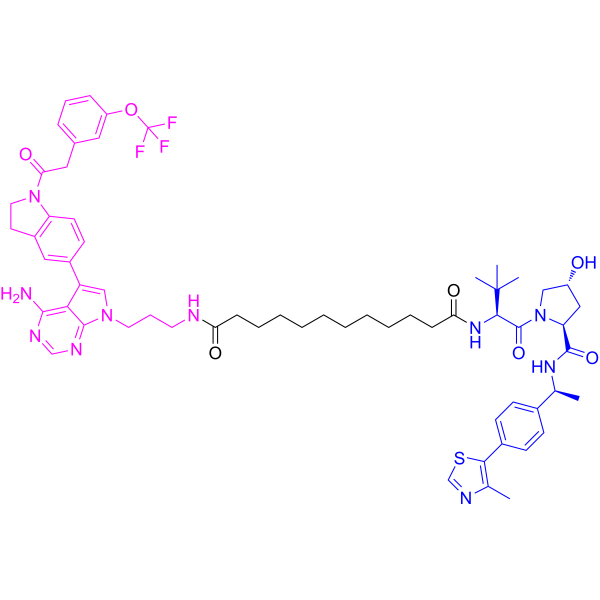
LD4172 is a selective RIPK1 PROTAC degrader with a Ki of 4.8 nM. LD4172 induces RIPK1 protein degradation via ternary complex formation with RIPK1 and VHL E3 ligase, driving ubiquitination and proteasomal breakdown. LD4172 abrogates TNF-induced classical NF-κB signaling in TRAF2-deficient cells, impairing IκBα phosphorylation and degradation, and reducing IL-8 production. LD4172 induces apoptosis and immunogenic cell death in tumor cells, enhances tumor-infiltrating lymphocyte responses, and sensitizes tumors to anti-PD1 therapy. LD4172 acts as a chemical probe for investigating RIPK1 scaffolding functions. LD4172 can be used for the research of melanoma, colon cancer .
loading...
    loading...
Cat. No.: HY-172930
CAS No.: 2991021-08-8
PVTX-405 is a selective and oral active IKZF2 molecular glue degrader with a DC50  of  0.7 nM and a Dmax of 91%. PVTX-405 enhances degradation efficiency, significantly reduces off-target degradation, and alleviates hERG inhibition with IC50 of 48 µM. PVTX-405 significantly inhibits the growth of MC38 tumors, with greater synergistic anti-cancer efficacy in combination with immune checkpoint therapies (ICTs) (anti-PD1 or anti-LAG3) in the MC38 mouse tumor xenograft model using Crbn 391V C57BL/6 mice .
loading...
    loading...
Cat. No.: HY-P99382A
Target:  

Others

Research Areas:  

Cancer

Vopratelimab (Mouse IgG2a) is a agonist monoclonal antibody that selectively targets Inducible CO-Stimulator of T cells (ICOS). The variable region of Vopratelimab (Mouse IgG2a) is consistent with that of Vopratelimab (HY-P99382), while the constant region is of Mouse IgG2a sequence. Vopratelimab (Mouse IgG2a) has antitumor immune response and enhances combinatorial efficacy with anti-PD-1 (HY-P9902A) therapy .
loading...
    loading...
Cat. No.: HY-146231
CAS No.: 2636072-62-1
Target:  

PROTACs MAP4K

Research Areas:  

Inflammation/Immunology Cancer

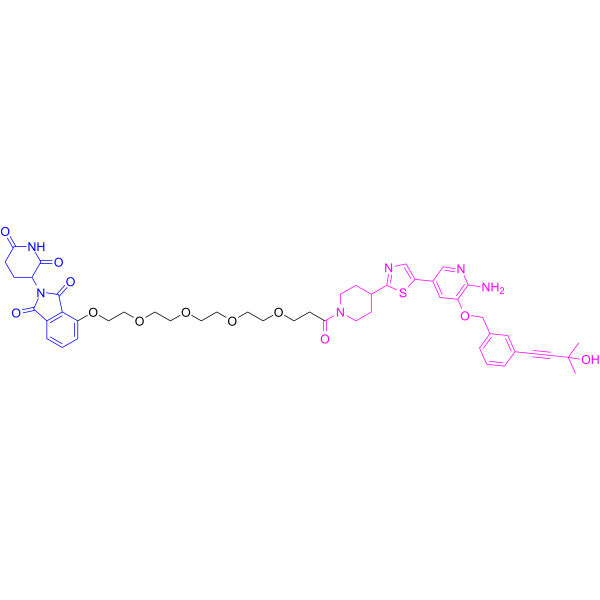
SS47 is a hematopoietic progenitor kinase HPK1 PROTAC-class degrader and immune activator. SS47 promotes the proliferation of CD4+ and CD8+ T cells as well as IFN-γ secretion, and enhances the anti-tumor cytotoxicity and in vivo efficacy of BCMA CAR-T cells. SS47 also inhibits tumor growth in mouse models, and when combined with anti-PD-1 therapy, it improves the immune response of 4T1 tumor-bearing mice. SS47 can be used in breast cancer-related research .
loading...
    loading...
Cat. No.: HY-146231A
Purity:  99.88%
Target:  

PROTACs MAP4K

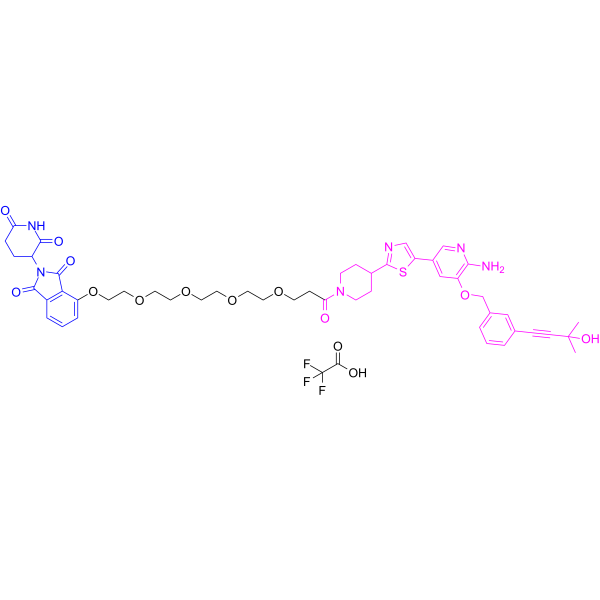
SS47 TFA is a hematopoietic progenitor kinase HPK1 PROTAC-class degrader and immune activator. SS47 TFA promotes the proliferation of CD4+ and CD8+ T cells as well as IFN-γ secretion, and enhances the anti-tumor cytotoxicity and in vivo efficacy of BCMA CAR-T cells. SS47 TFA also inhibits tumor growth in mouse models, and when combined with anti-PD-1 therapy, it improves the immune response of 4T1 tumor-bearing mice. SS47 TFA can be used in breast cancer-related research .
loading...
    loading...
Cat. No.: HY-P990716
CAS No.: 2648346-74-9
Synonyms: AZD7789

Target:  

PD-1/PD-L1 Tim3

Research Areas:  

Inflammation/Immunology

Sabestomig (AZD7789) is a monovalent bispecific antibody targeting PD-1 and TIM-3. Sabestomig binds to PD-1 and an epitope in the TIM-3 IgV domain outside the phosphatidylserine-binding cleft, thereby precisely regulating immune responses. Sabestomig promotes IL-2 production, efferocytosis and cross-presentation of tumor antigens, and enhances the release of anti-tumor T cell cytokines, cytotoxicity, and secretion of IFN-γ. Sabestomig inhibits the growth of solid tumors, prolongs the duration of tumor suppression, and significantly enhances anti-tumor responses following anti-PD-1 therapy. Sabestomig has been used in studies related to non-small cell lung cancer and classical Hodgkin lymphoma .
loading...
    loading...
Cat. No.: HY-L266
101 compounds

PD-1/PD-L1 signaling is a central negative regulatory axis that maintains immune homeostasis. It involves the specific binding of PD-1 to its ligands PD-L1/PD-L2 and the subsequent transduction of inhibitory signals, which suppress T cell activation and proliferation, drive T cell exhaustion, and contribute to tumor immune evasion. Dysregulation of this pathway is closely linked to major diseases including cancer, chronic viral infections, autoimmune disorders, and transplant rejection. Immune checkpoint blockade targeting PD-1/PD-L1 has emerged as a leading frontier in cancer therapy and mechanistic research.

The MCE PD-1 Compound Library contains 101 structurally defined small molecules, covering modulators related to the PD-1/PD-L1 signaling pathway. It can be used for cancer immunotherapy research, studies of immune resistance mechanisms, and candidate compound screening, providing chemical tools for immune checkpoint mechanism research, drug discovery, and high-throughput screening.

Cat. No.: HY-189235
CAS No.: 3078735-55-1
Target:  

5-HT Receptor

Research Areas:  

Cancer

IHCH-8110 is a peripherally restricted, non-brain-penetrant 5-HT2AR and 5-HT2CR agonist (Ki=47.86 nM) that antagonizes 5-HT2BR. IHCH-8110 induces CXCL10 and IL-18 expression by activating 5-HT2AR on enteric glial cells, thereby promoting CD8 + T cell recruitment and effector polarization, and avoids the risk of cardiac valvulopathy associated with 5-HT2BR activation. IHCH-8110 exhibits a low risk of hERG channel inhibition (IC50=5.96 μM) and is well tolerated, sensitizing immunologically cold colorectal cancer to PD-1 blockade therapy, making it suitable for research related to colorectal cancer .
loading...
    loading...
Cat. No.: HY-L031
840 compounds

Immuno-Oncology is a type of immunotherapy that has the specific purpose of treating cancer. It works by stimulating our immune system to fight back. Normally, our immune system is able to destroy cancer cells in our body, however sometimes cancer cells can adapt and mutate, effectively hiding from our immune system. This is when tumors can develop and become a threat to our health. Immuno-oncology involves mobilizing lymphocytes to recognize and eliminate cancer cells using the body’s immune system. There are several immuno-oncology treatments available, including Immune cell therapy (CAR-T), monoclonal antibodies (mABs) and checkpoint inhibitors, cytokines and cancer vaccines.

MCE Small Molecule Immuno-Oncology Compound Library offers 840 bioactive tumor immunology compounds that target some important checkpoints such as PD1/PD-L1, CXCR, Sting, IDO, TLR, etc. This library is a useful tool for Immuno-oncology research.

Cat. No.: HY-181816
CAS No.: 3095344-37-6
Target:  

PD-1/PD-L1

Research Areas:  

Cancer

PD-1/PD-L1-IN-60 is the counterpart of the small-molecule immuno-probe [ 18F] LG‑8, and the two together enable integrated immuno-diagnosis and therapy. PD-1/PD-L1-IN-60 exhibits potent anti-tumor activity in mouse models of melanoma and lung cancer with high PD‑L1 uptake. PD-1/PD-L1-IN-60 can be used for relevant research on melanoma and lung cancer .
loading...
    loading...
Cat. No.: HY-184555
Research Areas:  

Cancer

TP-18 is a potent and orally active dual EP2/EP4 antagonist with IC50 values of 9.5 nM (EP2) and 3.3 nM (EP4). TP-18 effectively depletes a highly immunosuppressive VSIG4high tumor-associated macrophage (TAM) subset and enhances cytotoxic CD8+ T cell-mediated colorectal cancer (CRC) tumor elimination. TP-18 dampens the expression of VSIG4 by blunting EP2/EP4-Gαs-PKA signaling. TP-18 enhances the sensitivity of anti-PD-1 therapy in CRC mouse models and in patient-derived tumor immune organoids. TP-18 can be used to study colorectal cancer .
loading...
    loading...
Cat. No.: HY-P992353

Target:  

LILRB

Research Areas:  

Cancer

ES009 is a high-affinity LILRB2 antagonist, with IC50 values of 14.07 nM and 18.61 nM for inhibiting hLILRB2-huANGPTL3 and hLILRB2-huANGPTL4, respectively. ES009 specifically blocks the interactions between LILRB2 and MHC class I as well as non-MHC ligands, thereby effectively inhibiting receptor activation. ES009 can reprogram anti-inflammatory myeloid cells and induce their conversion to a pro-inflammatory phenotype, and also reverse the T cell suppression mediated by macrophages. When combined with anti-PD-1 blockade therapy, ES009 synergistically enhances T cell activation. ES009 can be used in research related to advanced solid tumors and ovarian cancer .
loading...
    loading...
Cat. No.: HY-179476
CAS No.: 847232-54-6
3-Oxochol-5-en-24-oic acid is a rare bile acid produced by the intestinal microbiota. 3-Oxochol-5-en-24-oic acid is a potent antagonist of the human androgen receptor (hAR), with an IC50 of 119.4 nM. 3-Oxochol-5-en-24-oic acid has no significant agonistic or antagonistic effects on estrogen receptors (ER) or glucocorticoid receptors (GR). 3-Oxochol-5-en-24-oic acid effectively inhibits the growth of prostate cancer cells. In animal models, it enhances the efficacy of anti-PD-1 therapy by regulating the differentiation of CD8 + T cells. 3-Oxochol-5-en-24-oic acid can be used for research on regulating host immunity and anti-tumor studies .
loading...
    loading...
Cat. No.: HY-N20707
CAS No.: 24312-00-3
Castalagin is an orally active natural product with multiple biological activities including antibacterial activity against bacteria and anti-leishmanial activity against Leishmania aethiopica. Castalagin exhibits inhibitory activity against PARP1 and DNA topoisomerase II, with an IC50 of 0.86 μM for bovine PARP1. Castalagin reduces poly (ADP-ribosyl) ation modification in cells. Castalagin binds to the cell envelope of Ruminococcus bromii, increases the ratio of CD8+/FOXP3+CD4+ T cells in the tumor microenvironment, and acts as a prebiotic to enhance the activity of anti-PD-1 therapy. Castalagin induces morphological changes in Leishmania aethiopica promastigotes and inhibits their proliferation. Castalagin inhibits PBP2a-mediated peptidoglycan layer stabilization, disrupts bacterial peptidoglycan assembly, and inhibits and disintegrates bacterial biofilms. Castalagin can be used in research related to diseases such as cancer, leishmaniasis, and bacterial infections .
loading...
    loading...
Cat. No.: HY-184931
Research Areas:  

Cancer

PTPN22-IN-3 is a potent, selective, and orally active inhibitor of PTPN22 with an IC50 of 0.49 μM and a Ki of 0.28 μM. PTPN22-IN-3 exhibits over 14-fold selectivity against a broad panel of PTPs and shows no significant inhibition against SRC/CSK kinases or IDO1/Arginase metalloenzymes. PTPN22-IN-3 enhances TCR signaling, increases IL-2 expression and secretion, and promotes mouse splenic T cell proliferation. In immune-competent C57BL/6J mice, PTPN22-IN-3 suppresses MC38 syngeneic tumor growth and synergizes with Pembrolizumab (anti-PD-1) (HY-P9902A) therapy. PTPN22-IN-3 can be used for the study of colorectal cancer and other solid tumors responsive to T cell-mediated anti-tumor immunity .
loading...
    loading...
  • 1

