13 Results for "

PROTAC warhead

" in MedChemExpress (MCE) Product Catalog:
Products (13)

13 Results for "PROTAC warhead" in MCE Product Catalog:

2
2 Cited Publications
Cat. No.: HY-137516
CAS No.: 2502156-03-6
Purity:  98.16%
Research Areas:  

Cancer

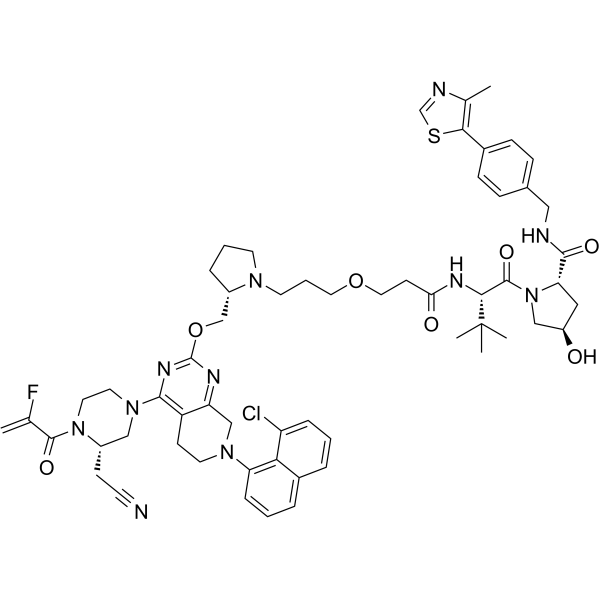
LC-2 is an orally active PROTAC-class degrader targeting KRAS G12C and a MAPK inhibitor. LC-2 shows higher selectivity for KRAS G12C than wild-type KRAS and other KRAS mutants. LC-2 covalently binds to KRAS G12C via the MRTX849 (HY-130149) warhead, recruits the VHL E3 ligase to form a ternary complex, and induces ubiquitination and degradation of KRAS G12C. Meanwhile, LC-2 inhibits the MAPK signaling pathway, reduces the phosphorylation levels of CRAF and AKT, thereby inducing apoptosis and suppressing cancer cell and tumor growth. LC-2 can be used for the research of KRAS G12C-positive cancers, including non-small cell lung cancer and colorectal cancer .
loading...
    loading...
Cat. No.: HY-107443
CAS No.: 1300019-38-8
Purity:  99.55%
Synonyms: Molibresib carboxylic acid; GSK525762A carboxylic acid; PROTAC BRD4-binding moiety 2
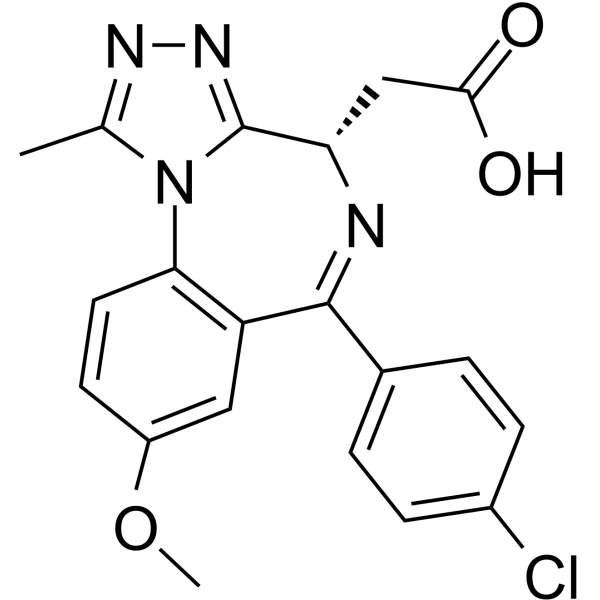
I-BET762 carboxylic acid (Molibresib carboxylic acid) is an I-BET762-based warhead ligand for conjugation reactions of PROTAC targeting on BET. I-BET762 carboxylic acid (Molibresib carboxylic acid) is a BRD4 inhibitor with a pIC50 of 5.1 .
loading...
    loading...
Cat. No.: HY-164977
CAS No.: 3093519-24-2
Target:  

PROTACs Phosphatase

Research Areas:  

Cancer

JCS-1 is a potent DcpS PROTAC degrader. JCS-1 non-covalently binds DcpS with a RG3039-based warhead and recruits the E3 ligase VHL. JCS-1 promotes ubiquitination and degradation of DcpS at nanomolar concentrations (DC50 in MOLM-14 cells: 87 nM). JCS-1 can be used for the research of AML and other DcpS-dependent genetic disorders .
loading...
    loading...
Cat. No.: HY-163810
CAS No.: 3033018-77-5
BRD9 Degrader-3 is a selective BRD9 BRD9 molecular glue degrader degrader. BRD9 Degrader-3 consists of a BRD9-binding ligand, a linker, and a warhead that promotes proteasomal degradation of BRD9 via a non-canonical PROTAC mechanism independent of CRBN or VHL E3 ligases. BRD9 Degrader-3 can be used in cancer research, including studies of malignant rhabdoid tumors, specific sarcomas, and acute myeloid leukemia .
loading...
    loading...
Cat. No.: HY-107443A
CAS No.: 1786401-70-4
Purity:  99.50%
Synonyms: (R)-Molibresib carboxylic acid; (R)-GSK525762A carboxylic acid; (R)-PROTAC BRD4-binding moiety 2
(R)-I-BET762 carboxylic acid, the R-enantiomer of I-BET762 carboxylic acid (HY-107443). I-BET762 carboxylic acid is an I-BET762-based warhead ligand for conjugation reactions of PROTAC targeting on BET. I-BET762 carboxylic acid is a BRD4 inhibitor with a pIC50 value of 5.1 .
loading...
    loading...
Cat. No.: HY-163809
CAS No.: 3033018-68-4
BRD9 Degrader-2 is a selective BRD9 molecular glue degrader. BRD9 Degrader-2 consists of a BRD9-binding ligand, a linker, and a warhead that promotes proteasomal degradation of BRD9 via a non-canonical PROTAC mechanism independent of CRBN or VHL E3 ligases. BRD9 Degrader-2 can be used in cancer research, including studies of malignant rhabdoid tumors, specific sarcomas, and acute myeloid leukemia .
loading...
    loading...
Cat. No.: HY-107443R
CAS No.: 1300019-38-8
Synonyms: Molibresib carboxylic acid (Standard); GSK525762A carboxylic acid (Standard); PROTAC BRD4-binding moiety 2 (Standard)
I-BET762 carboxylic acid (Standard) is the analytical standard of I-BET762 carboxylic acid (HY-107443). This product is intended for research and analytical applications. I-BET762 carboxylic acid (Molibresib carboxylic acid) is an I-BET762-based warhead ligand for conjugation reactions of PROTAC targeting on BET. I-BET762 carboxylic acid (Molibresib carboxylic acid) is a BRD4 inhibitor with a pIC50 of 5.1 .
loading...
    loading...
Cat. No.: HY-183892
CAS No.: 2690350-15-1
Research Areas:  

Cancer

d9A1-2 is a potent SLC9A1 PROTAC degrader. d9A1-2 binds to SLC9A1 via the d9A1 warhead, recruits the CRL4CRBN E3 ubiquitin ligase through EBM, and thereby induces ubiquitination and proteasomal degradation of SLC9A1. d9A1-2 can be used for research on cancers such as acute myeloid leukemia .
loading...
    loading...
Cat. No.: HY-107443AR
CAS No.: 1786401-70-4
Synonyms: (R)-Molibresib carboxylic acid (Standard); (R)-GSK525762A carboxylic acid (Standard); (R)-PROTAC BRD4-binding moiety 2 (Standard)
(R)-I-BET762 carboxylic acid (Standard) is the analytical standard of (R)-I-BET762 carboxylic acid (HY-107443A). This product is intended for research and analytical applications. (R)-I-BET762 carboxylic acid, the R-enantiomer of I-BET762 carboxylic acid (HY-107443). I-BET762 carboxylic acid is an I-BET762-based warhead ligand for conjugation reactions of PROTAC targeting on BET. I-BET762 carboxylic acid is a BRD4 inhibitor with a pIC50 value of 5.1 .
loading...
    loading...
Cat. No.: HY-130646
CAS No.: 2472645-27-3
Target:  

PROTACs PARP

Research Areas:  

Cancer

iVeliparib-AP6 is a proteolysis-targeting chimera (PROTAC) molecule designed based on Veliparib (HY-10129), which targets PARP1/2. The DC50s of iVeliparib-AP6 for inducing the degradation of PARP1 and PARP2 are 36 nM and 63 nM, respectively, and its IC50s are 69 nM and 21 nM, respectively. iVeliparib-AP6 contains a Veliparib-based PARP inhibitor warhead linked to a CRBN E3 ligase binder; it uses Thalidomide (HY-14658) as a ligand to recruit CRBN E3 ubiquitin ligase and exerts the PARP2 degradation mechanism .
loading...
    loading...
Cat. No.: HY-180976
Target:  

PROTACs α-synuclein

Research Areas:  

Neurological Disease

Arg-PEG1-Tαsyn is an α-syn PROTAC degrader with a DC50 of 0.28 μM in U251 cells. Arg-PEG1-Tαsyn employs the amino acid arginine (Arg) as the E3 ligase UBR1 ligand and a benzothiazole-aniline variant as the warhead for α-syn. Arg-PEG1-Tαsyn significantly reduces α-syn aggregates and improves the dopaminergic neuronal impairment and the locomotion with safety profile in vivo.Arg-PEG1-Tαsyn shows the high degradation effect in mammalian cells for both wild-type α-syn and the α-syn (A53T) mutant. Arg-PEG1-Tαsyn can be used for Parkinson’s disease research .
loading...
    loading...
Cat. No.: HY-L945
100 compounds

Sulfonyl fluoride (-SO₂F) overcomes the poor target selectivity of traditional covalent warheads that rely heavily on cysteine. With high stability and tunable electrophilicity under physiological conditions, it targets multiple nucleophilic residues including Lys, Tyr, Ser and His, offering expanded druggable space, lower off-target risks and prolonged efficacy. It is widely used in covalent inhibitors, molecular glues, PROTACs and chemical probes.

MCE has built a highly diverse sulfonyl fluoride fragment library with 1,162 structurally diverse, drug-like fragments. Designed for balanced reactivity, stability and compatibility, these molecules feature tunable electrophilicity, simple scaffolds and high derivatization potential. Combined with SuFEx click chemistry, the library enables efficient modular modification and rapid structure optimization.

Ideal for targeting non-cysteine residues, this library improves covalent screening and probe development efficiency, serving as a precise tool for early-stage covalent drug discovery and chemical biology research.

Cat. No.: HY-L934
122 compounds

CRBN, namely cereblon, is the substrate recognition subunit of the E3 ubiquitin ligase complex in the ubiquitin-proteasome system. A CRBN ligand library refers to a collection of numerous fragments that can specifically bind to the CRBN protein.

These ligands are mostly designed based on validated CRBN-binding warheads and modified through AI-driven molecular generation optimization systems. They not only include classic lenalidomide-derived structures but also cover novel non-lenalidomide scaffolds. After drug-likeness filtering, these ligands exhibit structural diversity and favorable druggable properties. They can be further optimized and modified to facilitate the development of novel molecular glue degraders, accelerate the discovery of molecular glues that induce interactions between CRBN and new substrate proteins, and enable the exploration of novel CRBN substrates for identifying previously unknown CRBN-binding proteins.

MCE compiles 122 fragments that can specifically bind to the CRBN protein, with molecular weights ranging from 200 to 500. Compounds developed based on the library ligands target multiple disease targets such as cancer and autoimmune diseases, further advancing the development of Molecular Glues and PROTACs therapeutic agents.

  • 1

