7 Results for "

Streptococcus faecium

" in MedChemExpress (MCE) Product Catalog:
Products (7)

7 Results for "Streptococcus faecium" in MCE Product Catalog:

Cat. No.: HY-116863
CAS No.: 865285-47-8
Purity:  95.70%
Target:  

Bacterial

Research Areas:  

Infection

KKL-40 is a small molecule inhibitor that targets the trans-transcription process and is effective against methicillin-sensitive and -resistant Staphylococcus aureus (S. aureus) as well as other Gram-positive pathogens including vancomycin-resistant Enterococcus faecium, Bacillus subtilis, and Streptococcus pyogenes. KKL-40 synergizes with the human antimicrobial peptide LL-37 to inhibit S. aureus, but does not synergize with other antibiotics such as daptomycin, kanamycin, or erythromycin. Trans-transcription is an extreme form of recoding, and KKL-40 inhibits trans-transcription but is nontoxic to HeLa cells .
loading...
    loading...
Cat. No.: HY-178952
Target:  

Bacterial

Research Areas:  

Infection

Anti-infective agent 12 (Compound A09) is a competitive inhibitor of type I signal peptidease (SPase I), with an IC50 of 4.475 μM and a Kd of 16.3 μM. Anti-infective agent 12 has the ability to disrupt bacterial membranes and remove biofilms. Anti-infective agent 12 exhibits potent bactericidal activity against Gram-positive bacteria, with MIC values of 4, 4, 8, and 8 μg/mL for Staphylococcus aureus, Enterococcus faecalis, Enterococcus faecium, and Streptococcus suis, respectively. Anti-infective agent 12 remains effective against multi-drug resistant strains, but has weaker activity against Gram-negative bacteria (such as Escherichia coli and Salmonella), with MIC values > 64 μg/mL. Anti-infective agent 12 has low hemolytic activity and shows significant efficacy in mouse skin infection models .
loading...
    loading...
Cat. No.: HY-121785
CAS No.: 54931-98-5
Target:  

Bacterial

Research Areas:  

Infection Cancer

10-Thiofolic acid is a potent antibacterial and antitumor agent. 10-Thiofolic acid inhibits the growth of Streptococcus faecium (ATCC 8043) and Lactobacillus casei (ATCC 7469). 10-Thiofolic acid has the potential for the research of leukemia .
loading...
    loading...
Cat. No.: HY-122518
CAS No.: 51989-25-4
Target:  

Bacterial

Research Areas:  

Inflammation/Immunology

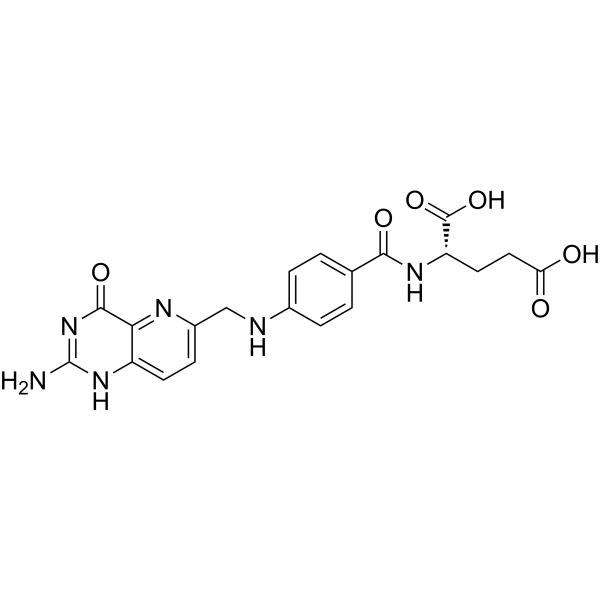
8-Deazafolic acid is an antimicrobial drug for the folate-dependent bacteria, Streptococcus faecium (ATCC 8043) and Lactobacillus casei (ATCC 74691). 8-Deazafolic acid has activity against lymphoid leukemia L1210 in mice .
loading...
    loading...
Cat. No.: HY-116863R
CAS No.: 865285-47-8
Research Areas:  

Infection

KKL-40 (Standard) is the analytical standard of KKL-40 (HY-116863). This product is intended for research and analytical applications. KKL-40 is a small molecule inhibitor that targets the trans-transcription process and is effective against methicillin-sensitive and -resistant Staphylococcus aureus (S. aureus) as well as other Gram-positive pathogens including vancomycin-resistant Enterococcus faecium, Bacillus subtilis, and Streptococcus pyogenes. KKL-40 synergizes with the human antimicrobial peptide LL-37 to inhibit S. aureus, but does not synergize with other antibiotics such as daptomycin, kanamycin, or erythromycin. Trans-transcription is an extreme form of recoding, and KKL-40 inhibits trans-transcription but is nontoxic to HeLa cells .
loading...
    loading...
Cat. No.: HY-187554
CAS No.: 1091682-50-6
Target:  

Antibiotic Bacterial

Research Areas:  

Infection

IDP-73152 is an orally active bacterial Peptide deformylase inhibitor and Antibiotic. IDP-73152 exhibits activity against Gram-positive bacteria. IDP-73152 can be used in the research of infections caused by Streptococcus pneumoniae, Enterococcus faecium and Staphylococcus aureus .
loading...
    loading...
Cat. No.: HY-187554A
CAS No.: 1936442-71-5
Target:  

Antibiotic Bacterial

Research Areas:  

Infection

IDP-73152 mesylate is an orally active bacterial Peptide deformylase inhibitor and Antibiotic. IDP-73152 mesylate exhibits activity against Gram-positive bacteria. IDP-73152 mesylate can be used in the research of infections caused by Streptococcus pneumoniae, Enterococcus faecium and Staphylococcus aureus .
loading...
    loading...

