5 Results for "

diatom cells

" in MedChemExpress (MCE) Product Catalog:
Products (5)

5 Results for "diatom cells" in MCE Product Catalog:

Cat. No.: HY-133684
CAS No.: 202284-87-5
Purity:  99.63%
Target:  

Bacterial

Research Areas:  

Infection

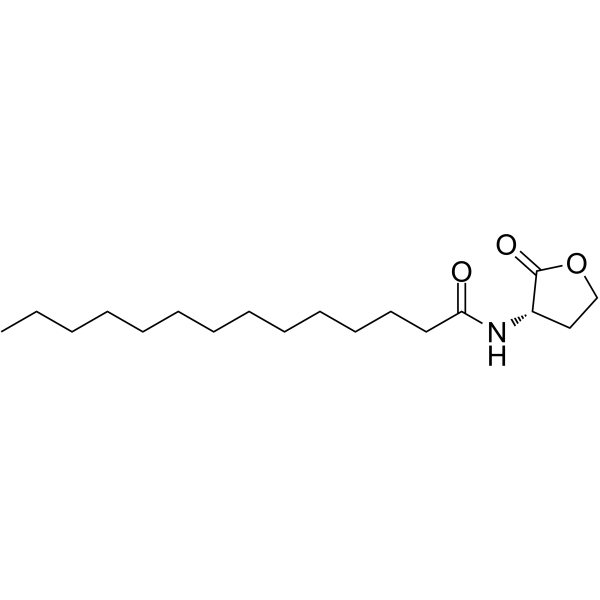
N-Tetradecanoyl-L-homoserine lactone is a short-chained N-acyl homoserine lactone (AHL). Diatoms are frequently found in association with Proteobacteria, many members of which employ cell-to-cell communication via AHLs in aquatic habitats .
loading...
    loading...
Cat. No.: HY-133684R
CAS No.: 202284-87-5
Research Areas:  

Infection

N-Tetradecanoyl-L-homoserine lactone (Standard) is the analytical standard of N-Tetradecanoyl-L-homoserine lactone (HY-133684). This product is intended for research and analytical applications. N-Tetradecanoyl-L-homoserine lactone is a short-chained N-acyl homoserine lactone (AHL). Diatoms are frequently found in association with Proteobacteria, many members of which employ cell-to-cell communication via AHLs in aquatic habitats.
loading...
    loading...
Cat. No.: HY-133685S
CAS No.: 2705226-73-7
Synonyms: C6-HSL-d3
N-Hexanoyl-L-Homoserine lactone-d3 (C6-HSL-d3) is deuterium labeled N-Hexanoyl-L-homoserine lactone. N-Hexanoyl-L-homoserine lactone is a short-chained N-acyl homoserine lactone (AHL). Diatoms are frequently found in association with Proteobacteria, many members of which employ cell-to-cell communication via AHLs in aquatic habitats .
loading...
    loading...
Cat. No.: HY-N15688
CAS No.: 31063-73-7
Diatoxanthin is a cytochrome and phycoxanthin byproduct that can be extracted from the algae F. pinnata cells. Diatoxanthin can be used as a biomarker to evaluate the inhibitory effects of biocides on diatom photosystem II (PSII) .
loading...
    loading...
Cat. No.: HY-111216
CAS No.: 87958-67-6
Target:  

Melatonin Receptor

Research Areas:  

Cancer

CGP52608 is a selective agonist for the RZR/ROR receptor, known for its anti-tumor activity, and has almost no affinity for the cell surface G-protein coupled melatonin receptor. CGP52608 can inhibit the growth of mouse 16/C breast cancer cells. CGP52608 can induce the formation of vesicles in diatoms .
loading...
    loading...

