7 Results for "

hallucinogen

" in MedChemExpress (MCE) Product Catalog:
Products (7)

7 Results for "hallucinogen" in MCE Product Catalog:

Cat. No.: HY-138218
CAS No.: 3270-02-8
Synonyms: 1-Acetyl-LSD
Research Areas:  

Neurological Disease

ALD-52 (1-Acetyl-LSD) is a prodrug for LSD. ALD-52 shows an affinity to 5-HT1A, 5-HT2A and 5-HT2C with a sub>D values of 1054, 174 and 10.2 nM, respectively. ALD-52 is converted to LSD and induces a head-twitch response (HTR) in vivo. ALD-52 can be used for hallucinogen research .
loading...
    loading...
Cat. No.: HY-Z8487
CAS No.: 1823362-29-3
Target:  

Drug Derivative

Research Areas:  

Neurological Disease

2-(2-Chlorophenyl)-2-hydroxycyclohexanone is structurally similar to known hallucinogens that is an impurity in Esketamine preparations .
loading...
    loading...
Cat. No.: HY-157429
CAS No.: 2865185-31-3
Target:  

5-HT Receptor

Research Areas:  

Neurological Disease

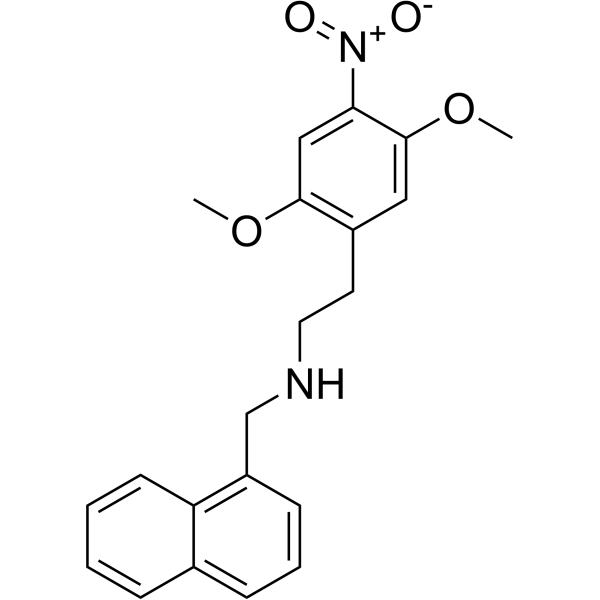
25N-N1-Nap is a blood-brain barrier-permeable, selective, β-arrestin2-biased 5-HT2A receptor (5-HT2AR) agonist. 25N-N1-Nap reduces Gq efficacy while preserving β-arrestin2 efficacy. 25N-N1-Nap does not induce hallucinogen-like behavioral responses, blocks hyperactivity induced by hallucinogens and psychostimulants, and induces rapid tolerance to hallucinogen-like responses. 25N-N1-Nap can be used for research on schizophrenia-related hyperactivity .
loading...
    loading...
Cat. No.: HY-W505344
CAS No.: 219986-78-4
Research Areas:  

Neurological Disease

Bromo-DragonFLY hydrochloride is an orally active benzodifuran psychoactive substance with hallucinogen-related activity. Bromo-dragonFLY hydrochloride is a 5-HT2A receptor agonist and MAO-A inhibitor that activates the Gαq-PLC-β/IP1/calcium signaling pathway and targets serotonin subtypes associated with hallucinogenic effects. Bromo-dragonFLY hydrochloride produces full substitution for the LSD stimulus in LSD-trained rats in drug discrimination experiments, induces head-twitch responses in mice, and blocks hERG potassium channels. Bromo-dragonFLY hydrochloride can be used in research related to neurological diseases .
loading...
    loading...
Cat. No.: HY-170053
CAS No.: 763035-03-6
Synonyms: 4-OH-MPT; Meprocin
Target:  

5-HT Receptor

Research Areas:  

Neurological Disease

4-Hydroxy MPT (4-OH-MPT), a serotonergic hallucinogen, is a 5-HT2A and 5-HT2B receptors agonist with EC50 values of 3.82 nM and 3.4 nM, respectively .
loading...
    loading...
Cat. No.: HY-L121
433 compounds

5-HT receptors, also called Serotonin receptors, are a group of G protein-coupled receptors (GPCRs) and ligand-gated ion channels (LGICs) found in the central and peripheral nervous systems. These receptors are now classified into seven families, 5-HT1–7, comprising a total of 14 structurally and pharmacologically distinct mammalian 5-HT receptor subtypes. The 5-HT receptors influence various biological and neurological processes such as aggression, anxiety, appetite, cognition, learning, memory, mood, nausea, sleep, andthermoregulation. The serotonin receptors are the target of a variety of pharmaceutical drugs, including many antidepressants, antipsychotics, anorectics, antiemetics, gastroprokinetic agents, antimigraine agents, hallucinogens, and entactogens.

MCE 5-HT Receptor Compound Library consists of 433 5-HT receptor inhibitors and activators, which can be used for neuropsychiatric disorders drugs discovery.

Cat. No.: HY-N20747
CAS No.: 28363-70-4
Synonyms: 4-Hydroxy-N-methyltryptamine; 4-HO-NMT
Norpsilocin (4-hydroxy-N-methyltrypt amine; 4-HO-NMT) is a natural tryptamine alkaloid isolated from the hallucinogenic mushroom Psilocybe cubensis. Norpsilocin activates human 5-HT2 receptors (5-HT2A: EC50 = 8.4 nM; 5-HT2B = 12.8 nM; 5-HT2C = 39.6 nM) and displays binding affinity toward 5-HT1 receptors (5-HT1B: Ki = 212 nM; 5-HT1D = 48.9 nM; 5-HT1E = 81.7 nM). Norpsilocin induces β-arrestin recruitment at the 5-HT1B receptor. Norpsilocin fails to produce psychedelic-like effects in mice, whereas high doses can induce hypothermia in vivo. Norpsilocin acts as an important research tool for exploring the structure–activity relationship of tryptamine hallucinogens and the pharmacology of serotonin receptors .
loading...
    loading...

