
11 Results for "

host invasion

" in MedChemExpress (MCE) Product Catalog:
Products (11)

11 Results for "host invasion" in MCE Product Catalog:

1
1 Cited Publications
Cat. No.: HY-P99364
CAS No.: 1024603-92-6
Synonyms: Anti-VEGFR1/FLT1 Reference Antibody; IMC-18F1

Target:  

VEGFR Apoptosis p38 MAPK Akt

Research Areas:  

Endocrinology Cancer

Icrucumab (Anti-VEGFR1/FLT1 Reference Antibody; IMC-18F1) is an IgG1 antibody inhibitor targeting VEGFR-1/FLT1 with anti-tumor activity. By blocking ligand-dependent phosphorylation and downstream signal transduction, Icrucumab reduces the activities of MAPK and Akt in breast cancer xenograft models, inhibits the proliferation and invasion of VEGFR-1-positive tumor cells, and reverses the conversion of M1 macrophages to the pro-tumor M2-like phenotype. Icrucumab also inhibits tumor cell proliferation, promotes apoptosis, and effectively suppresses tumor growth through direct targeting of tumors and host support mechanisms. In addition, Icrucumab exhibits a synergistic effect when combined with chemotherapeutic agents, and it is used in research related to various cancers including advanced solid malignancies, thyroid cancer, melanoma, and lung cancer .
loading...
    loading...
Cat. No.: HY-P5694
Research Areas:  

Infection

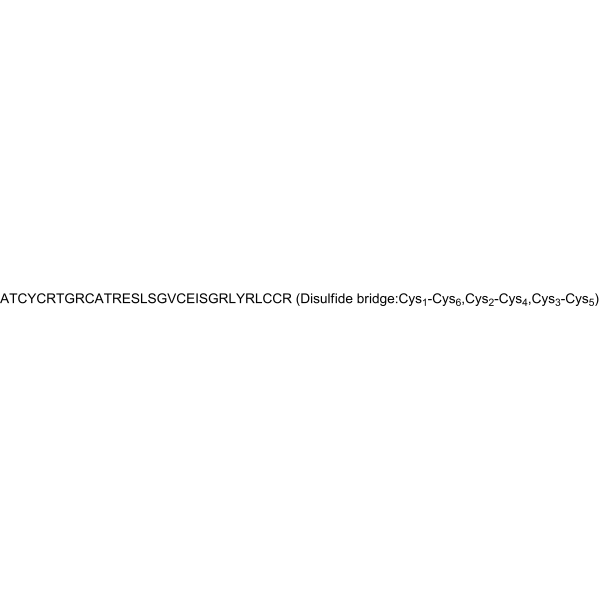
Human α-defensin 5 is an orally active antimicrobial peptide with diverse biological activities including antibacterial, antiviral, and antiparasitic effects. Human α-defensin 5 kills UPEC, inhibits bacterial biofilm formation, and disrupts bacterial outer membrane integrity. Human α-defensin 5 is hijacked by Shigella flexneri, enhancing Shigella adhesion, aggregation, and invasion of host epithelial cells, and aggravating histopathological damage in corneal and colonic tissues as well as fever. Human α-defensin 5 inhibits LPS-induced pro-inflammatory cytokine production and NF-κB signaling pathway activation, upregulates the tight junction proteins ZO-1 and occludin, and maintains intestinal epithelial barrier integrity. Human α-defensin 5 inhibits various non-enveloped viruses and exhibits killing activity against Toxoplasma gondii tachyzoites. Human α-defensin 5 reduces UPEC bacterial load in the bladder and urine and alleviates inflammatory damage in a rat catheter-associated urinary tract infection model. Human α-defensin 5 can be used in research related to bacterial infections, viral infections, parasitic infections, and inflammatory bowel disease .
loading...
    loading...
Cat. No.: HY-135477
CAS No.: 204130-08-5
Target:  

Phosphatase Bacterial

Research Areas:  

Infection

RWJ-60475 is a cell-permeable tyrosine phosphatase inhibitor with an IC50 of 3.3 μM. RWJ-60475, by inhibiting the activity of CD45/CD148 phosphatase, interferes with the phagocytic function of macrophages, thereby blocking the invasion of Legionella pneumophila into host cells and the transport of effector proteins. RWJ-60475 significantly reduces the uptake of bacterial particles by macrophages. RWJ-60475 can be used in the research of anti-infection targeting host factors .
loading...
    loading...
Cat. No.: HY-14644B
CAS No.: 870087-37-9
Synonyms: STA 5326 hydrochloride; LAM-002A free base hydrochloride; AIT-101 hydrochloride
Apilimod (STA 5326) hydrochloride is a PIKFYVE kinase inhibitor that promotes NLRP3 inflammatory vesicle activation and IL-1β secretion. Apilimod hydrochloride has been shown to inhibit host cell proteases, which may prevent viral invasion but also block antiviral immune responses, potentially exacerbating immunosuppression in COVID-19.
loading...
    loading...
Cat. No.: HY-124078
CAS No.: 114773-20-5
Target:  

Parasite

Research Areas:  

Infection

NIC is a host invasion inhibitor. NIC can suppress host invasion by interacting with the major invasion-related protein, merozoite surface protein 1 (MSP-1). NIC prevents the invasion of Plasmodium falciparum and Plasmodium vivax into the host .
loading...
    loading...
Cat. No.: HY-W706466
CAS No.: 106480-60-8
Synonyms: TCSA
Target:  

Fungal

Research Areas:  

Infection

3',5,5'-Trichlorosalicylanilide (TCSA) acts as an inhibitor of fungal morphogenesis, preventing biofilm formation and hindering host cell invasion.
loading...
    loading...
Cat. No.: HY-172207
Research Areas:  

Infection

POPTc80-IN-1 (Compound LC-45) is a competitive inhibitor for prolyl oligopeptidase of Trypanosoma cruzi POPTc80 with an IC50 of 0.23 μM and a Ki of 0.054 μM. POPTc80-IN-1 inhibits the invasion of T. cruzi into host cell with an IC50 of 46.71 μM .
loading...
    loading...
Cat. No.: HY-P9804
Synonyms: MERS-2E6; MERS Antibody-2E6

Target:  

SARS-CoV

Research Areas:  

Infection

Anti-MERS-2E6 mAb (MERS-2E6; MERS Antibody-2E6), a human neutralizing antibody IgG1 (CHO expressed) that can compete for the binding of the virus Spike protein to the receptor (CD26), thereby inhibiting virus invasion into host cells.
loading...
    loading...
Cat. No.: HY-128526
CAS No.: 160472-93-5
Target:  

Endogenous Metabolite

Research Areas:  

Infection

Acinetobactin is a bifunctional siderophore secreted by Acinetobacter baumannii that competitively binds ferric iron ions. Acinetobactin supplies A. baumannii by sequestering host-sequestered Fe 3+, while competitively depriving skin and respiratory commensal bacteria of iron resources, thereby exerting growth-inhibitory effects on Staphylococcus epidermidis, Staphylococcus hominis, Staphylococcus haemolyticus, and Corynebacterium striatum. The synthesis and transport of Acinetobactin enhance the intracellular epithelial colonization ability of A. baumannii, induce apoptosis of host epithelial cells, and simultaneously improve the survival and invasion capabilities of the bacterium in Galleria mellonella and mouse sepsis models. Acinetobactin can be used in A. baumannii-related research .
loading...
    loading...
Cat. No.: HY-182586
CAS No.: 19198-75-5
Target:  

Fungal Bcl-2 Family

Research Areas:  

Infection

Decyl gallate is an antifungal (fungal) agent. Decyl gallate downregulates the expression of the pro-apoptotic (apoptosis) protein Bak, upregulates the expression of the anti-apoptotic protein Bcl-2, and inhibits DNA damage. Decyl gallate disrupts ALG12-mediated N-glycosylation, overactivates the UPR pathway, and simultaneously reduces fungal cell wall enzyme activity, chitin levels, mitochondrial activity, budding ability, cell viability, and host cell adhesion capacity. Decyl gallate reduces inflammatory responses induced by fungal infection and disrupts fungal membrane structure. Decyl gallate can be used in studies related to paracoccidioidomycosis and invasive fungal infections .
loading...
    loading...
Cat. No.: HY-L940
5,815 compounds

Owing to the widespread transmission and frequent mutation of viral diseases, as well as the continuous emergence of new viruses and drug-resistant strains, antiviral drug development is facing increasingly stringent requirements. Antiviral compound libraries serve as important tools for drug screening, mechanism research and development, enabling the discovery and investigation of various antiviral drugs.

These compounds act through diverse antiviral mechanisms, targeting key steps in viral replication, assembly and invasion. They exert antiviral effects by inhibiting viral nucleic acid synthesis, blocking viral protein processing, and preventing viral binding to host cells. This library covers various types of antiviral compounds, including nucleosides, non-nucleosides, protease inhibitors and integrase inhibitors. It supports research on influenza virus, herpes virus, hepatitis virus, emerging respiratory viruses and other pathogens, and enables high-throughput screening of novel antiviral candidates to rapidly identify potential active compounds against diverse viruses. It also facilitates mechanistic studies to elucidate drug-target interactions and viral resistance mechanisms, and supports the screening of effective compounds against mutant strains for research on viral variation and drug resistance.

This antiviral library consists of 6,804 compounds with lead-like physicochemical properties. The core sources of the compounds include analogs of known antiviral molecues with a similarity score ≥ 0.6. MCE has collected more than 1450 antiviral molecules. As a small-molecule collection with both activity potential and structural modifiability, it provides strong support for antiviral drug research and development.

  • 1

