4 Results for "

insect olfactory

" in MedChemExpress (MCE) Product Catalog:
Products (4)

4 Results for "insect olfactory" in MCE Product Catalog:

Cat. No.: HY-125982
CAS No.: 525582-84-7
Purity:  ≥98.0%
Target:  

Insecticide

Research Areas:  

Others

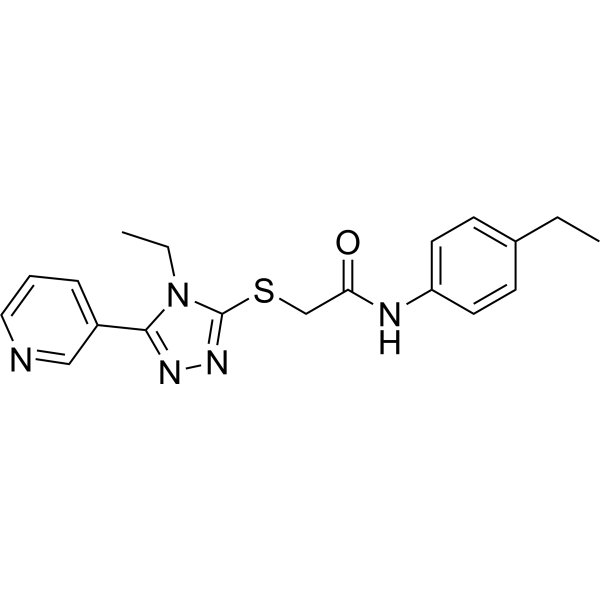
VUAA1 is an insect odorant co-receptor (Orco) agonist. VUAA1 activates both heteromeric and homomeric Orco-containing channels. VUAA1 can disrupt the destructive behaviors of nuisance insects. VUAA1 can be used for insect olfactory research .
loading...
    loading...
Cat. No.: HY-118967
CAS No.: 663212-40-6
Synonyms: VU0183254
Target:  

HCN Channel

Research Areas:  

Others

VUANT1 (VU0183254) is an allosteric antagonist of insect odorant receptor ion channels, which has the activity of inhibiting insect odorant receptor signaling. VUANT1 can inhibit the activation of insect odorant receptors through allosteric regulation, which is important for the study of the molecular mechanism of insect olfactory signaling. Although it may be of limited use in insect control programs, it can be used as a pharmacological tool to study related mechanisms.
loading...
    loading...
Cat. No.: HY-166051
CAS No.: 68820-32-6
Synonyms: Z4-11Al; (Z)-4-Undecenal
Research Areas:  

Others

4 (Z)-Undecenal (Z4-11Al; (Z)-4-Undecenal) is a volatile aldehyde sex pheromone produced by female Drosophila melanogaster, acting as an agonist to activate the Drosophila olfactory receptor Or69aB and eliciting flight attraction and courtship behavior in Drosophila. 4 (Z)-Undecenal also activates human OR2W1, binding to its binding site through hydrophobic interactions and hydrogen bonds. 4 (Z)-Undecenal can be used in research related to olfactory receptors and insect pheromones .
loading...
    loading...
Cat. No.: HY-121787
CAS No.: 136340-88-0
Synonyms: OLC20
Target:  

Olfactory Receptor

Research Areas:  

Others

OX1a (OLC20) is an Orco antagonist with non-competitive activity that inhibits the activation of oxygen odor receptors (ORs). OX1a is able to reduce the activation of ORs by competitively inhibiting the effects of Orco agonists. OX1a also shows non-competitive inhibition of odor molecules, which may affect the olfactory-mediated behavior of insects. Through structural optimization, OX1a analogs have shown higher antagonistic potency, indicating that this type of compound may have application potential in a wide range of insect species .
loading...
    loading...

