2 Results for "

microglial viability

" in MedChemExpress (MCE) Product Catalog:
Products (2)

2 Results for "microglial viability" in MCE Product Catalog:

1
1 Cited Publications
Cat. No.: HY-P1206
CAS No.: 174688-78-9
Target:  

Somatostatin Receptor

Research Areas:  

Neurological Disease

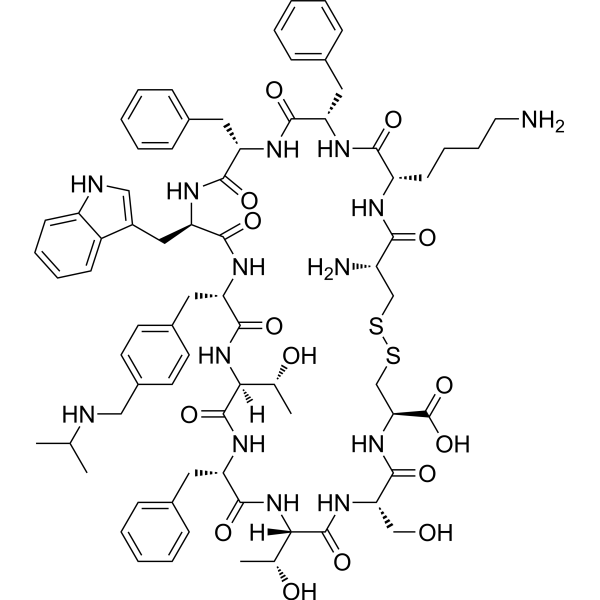
CH 275 is a peptidic somatostatin analog that acts as an agonist of SST1 (IC50 = 30.9 nM, Ki = 52 nM). The IC50 values of CH 275 for sst3, sst4, sst2, and sst5 are 345 nM, >1 μM, >10 μM, and >10 μM, respectively. CH 275 binds to SSTR1 via the IAmp9-Asp137 ion pair interaction and the hydrophobic interaction between the isopropyl group of IAmp9 and Leu107, and reduces the extracellular acidification rate. CH 275 induces weak sst1 internalization, exerts immunosuppressive effects on macrophages, and decreases macrophage viability, MCP-1 expression/secretion, and IL-8 secretion, but does not alter proMMP-9 secretion or IL-8 mRNA levels. CH 275 reduces hippocampal β-amyloid levels and alleviates plaque pathology without inducing hippocampal microglial activation. CH 275 is used in research on Alzheimer's disease, Parkinson's disease, and depression .
loading...
    loading...
Cat. No.: HY-107733
CAS No.: 191931-56-3
Purity:  98.36%
Research Areas:  

Metabolic Disease Cancer

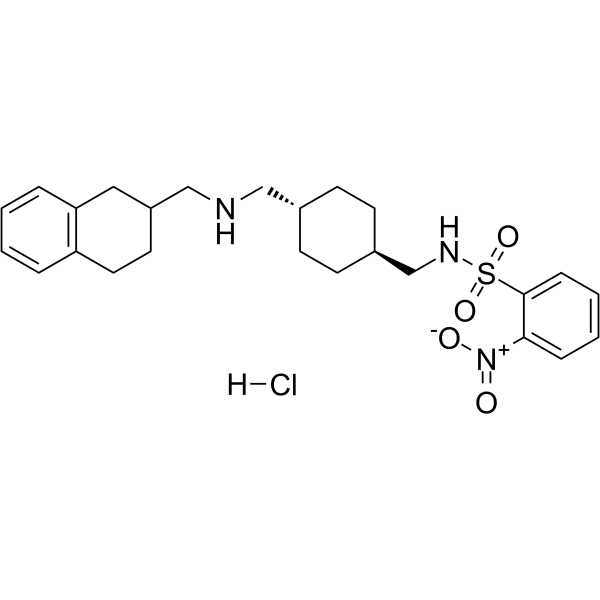
NTNCB hydrochloride is a selective neuropeptide Y Y5 (NPY Y5) receptor antagonist with a Ki value of 8 nM for human Y5. NTNCB hydrochloride inhibits the proliferation and metastasis of cancer cells, suppresses xenograft tumor growth in vivo, and induces apoptosis in cancer cells. NTNCB hydrochloride inhibits microglial viability and reverses AURKA, CDC20, CDK1, and EZH2 as well as several cancer-overexpressed genes in cancer cells. NTNCB hydrochloride can be used in research on castration-resistant prostate cancer, non-small cell lung cancer, and obesity .
loading...
    loading...

