6 Results for "

mouse urine

" in MedChemExpress (MCE) Product Catalog:
Products (6)

6 Results for "mouse urine" in MCE Product Catalog:

1
1 Cited Publications
Cat. No.: HY-128129
CAS No.: 892742-76-6
Purity:  99.68%
Target:  

Urea Transporter

Research Areas:  

Metabolic Disease

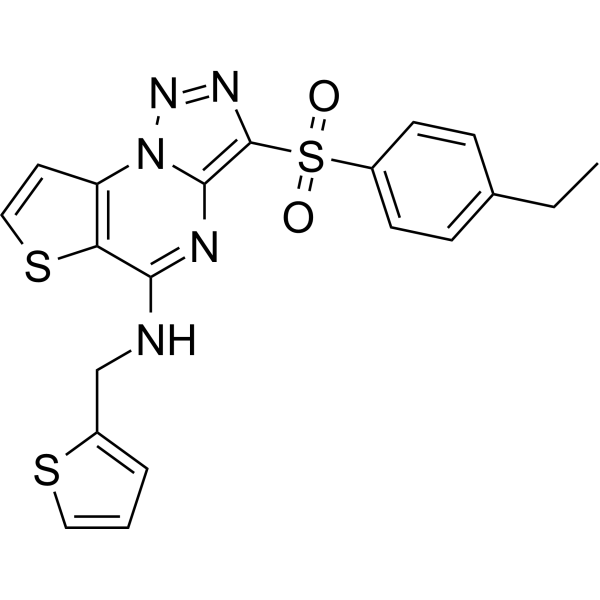
UT-B-IN-1 (UTBINH-14) is a reversible, competitive and selective urea transporter-B (UT-B) inhibitor with IC50 values of 10 and 25 nM for human and mouse UT-B, respectively. UT-B-IN-1 shows low toxicity and high selectivity for UT-B over UT-A isoforms. UT-B-IN-1 increases urine output and reduces urine osmolality of mice. UT-B-IN-1 can be used for diuretic mechanism research .
loading...
    loading...
Cat. No.: HY-W045990
CAS No.: 582-16-1
2,7-Dimethylnaphthalene is an inhibitor of CYP1A2 and CYP2A5, with an IC50 of 65 μM against CYP1A2. 2,7-Dimethylnaphthalene does not alter the levels of nicotine and its metabolites in mouse urine .
loading...
    loading...
Cat. No.: HY-P5490
CAS No.: 1370290-59-7
Synonyms: NPQ 53-70
Target:  

Inhibitory Antibodies

Research Areas:  

Others

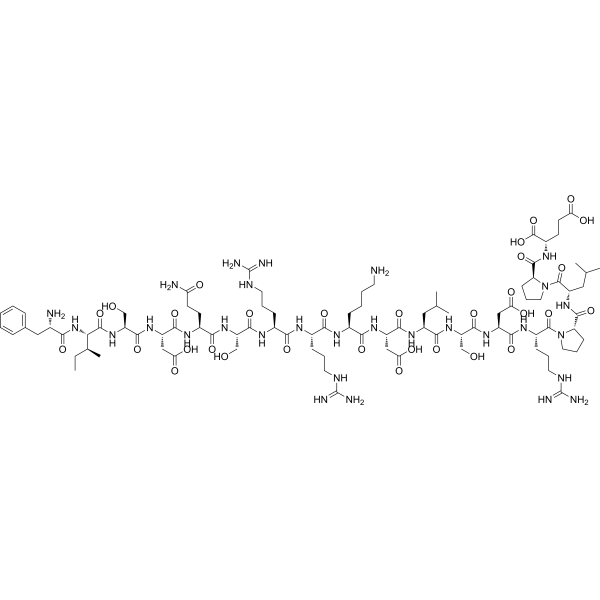
Spexin-2 (53-70), human,mouse,rat (NPQ 53-70) is a biological active peptide. (This is Spexin-2 (53-70), non-amidated version of the novel peptide hormone that is derived from prohormone proNPQ and is conserved amongst mammalian species. It is a central modulator of cardiovascular and renal function. Spexin-2, when administered to rats, decreases heart rate and increases urine flow rate)
loading...
    loading...
Cat. No.: HY-P11703
Target:  

MHC

Research Areas:  

Others

TRVLNLGPI is an MHC motif-containing, MHC-independent nonapeptide. TRVLNLGPI is not a product of immune presentation, but a product of renal protein degradation, and its concentration is sufficiently high to be specifically recognized by vomeronasal neurons. The concentration of TRVLNLGPI in mouse urine can be six orders of magnitude higher than that of prototype MHC-dependent peptides .
loading...
    loading...
Cat. No.: HY-185843
CAS No.: 1062136-15-5
Synonyms: dFdUTP
Target:  

Drug Metabolite

Research Areas:  

Cancer

2',2'-Difluorodeoxyuridine 5'-triphosphate (dFdUTP) is the intracellular phosphorylated metabolite of dFdU (HY-138253), which in turn is the deaminated metabolite of Gemcitabine (HY-17026). 2',2'-Difluorodeoxyuridine 5'-triphosphate incorporates into DNA and RNA, contributing to Gemcitabine-associated cytotoxicity and hepatotoxicity. 2',2'-Difluorodeoxyuridine 5'-triphosphate accumulates in the liver and kidneys of mice, and is detectable in mouse plasma and urine. 2',2'-Difluorodeoxyuridine 5'-triphosphate can be used in the research of breast cancer and non-small cell lung cancer .
loading...
    loading...
Cat. No.: HY-D3181
CyGbPF is a granzyme B-specific near-infrared fluorescent probe. CyGbPF can be cleaved by granzyme B to remove the peptide cage group, restoring near-infrared fluorescence. CyGbPF passively accumulates in mouse tumors, and its activated fluorescence correlates with granzyme B expression, CD8 + cytotoxic T lymphocyte populations, and CD4 + helper T lymphocyte populations in tumor tissues. CyGbPF is efficiently cleared by the kidneys, enabling the assessment of immune activation via optical urine analysis. CyGbPF allows real-time non-invasive evaluation of cancer immunotherapeutic efficacy in living animals. CyGbPF can be used in research on cancers such as breast cancer. Excitation wavelength/emission wavelength: approximately 658 nm/approximately 717 nm .
loading...
    loading...

