25 Results for "

two-photon probe

" in MedChemExpress (MCE) Product Catalog:
Products (25)

25 Results for "two-photon probe" in MCE Product Catalog:

Cat. No.: HY-D2465
Target:  

Fluorescent Dye

Research Areas:  

Infection

CY5-Dextran (MW60-80k) is a fluorescent probe formed by covalent conjugation of the cyanine dye Cy5 to dextran. It is a pH-insensitive fluid-phase endocytosis tracer (the pH of endosomal lumen is precisely quantified by the fluorescence ratio of FITC/Cy5). CY5-Dextran (MW60-80k) is internalized by cells via a clathrin-independent fluid-phase pinocytosis pathway, and is sequentially evidenced by early endosomes, late endosomes are transported to lysosomes. CY5-D I cannot pass through the limited pore size formed by uncoating of human rhinovirus type 2 (HRV2), but can be released into the neutral cytoplasm upon adenovirus-mediated endosomal rupture, thus distinguishing between the two viral modes of "pore-forming escape" and "lysis escape". CY5-Dextran (MW60) -80k) has an excitation wavelength of 635 nm, and it can also be used for time-lapse imaging of endocytosis dynamics of stromal cells in tissues such as rat salivary glands under in vivo two-photon microscopy .
loading...
    loading...
Cat. No.: HY-D2344
CAS No.: 325721-44-6
Synonyms: 3-Benzothiazole-daphnetin
3-BTD (3-Benzothiazole-daphnetin) is a Catechol-O-methyltransferase (COMT) two-photon fluorescence probe. 3-BTD can also be used for biological imaging of endogenous COMT in living cells and tissue sections .
loading...
    loading...
Cat. No.: HY-D2971
CAS No.: 2781892-92-8
NCIC-VIS is a lysosome-targeted, viscosity-sensitive two-photon near-infrared fluorescent probe. NCIC-VIS has a rigid structure that can restrict molecular torsion, thereby increasing the fluorescence quantum yield and two-photon absorption cross-section. NCIC-VIS enables real-time imaging of the autophagy process in cells .
loading...
    loading...
Cat. No.: HY-D1637
CAS No.: 172646-43-4
Target:  

Fluorescent Dye

Research Areas:  

Others

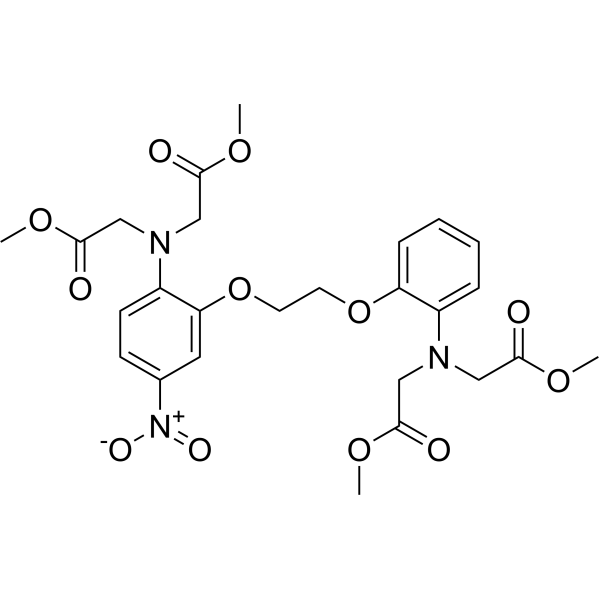
5-Nitro BAPTA tetramethyl ester is a calcium chelator. 5-Nitro BAPTA tetramethyl ester involves in the two-photon probe synthesis, and is used for real-time imaging of intracellular calcium ions, calcium waves monitoring at a depth of 100-300 μm in liver tissues for 1100-4000 s. 5-Nitro BAPTA tetramethyl ester, together with fluorescent compound 2-Me-substituted TM, can be used to form a red fluorescent probe (CaTM-2 AM) .
loading...
    loading...
Cat. No.: HY-139816
CAS No.: 2507992-93-8
Target:  

Fluorescent Dye

Research Areas:  

Neurological Disease

BTNPO is a unimolecular two-photon fluorescent probe.
loading...
    loading...
Cat. No.: HY-D1253
CAS No.: 2937819-61-7
Target:  

TrxR

Research Areas:  

Neurological Disease

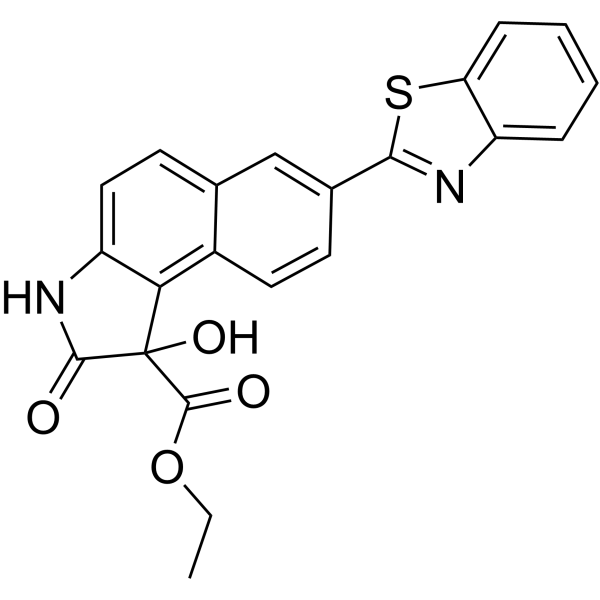
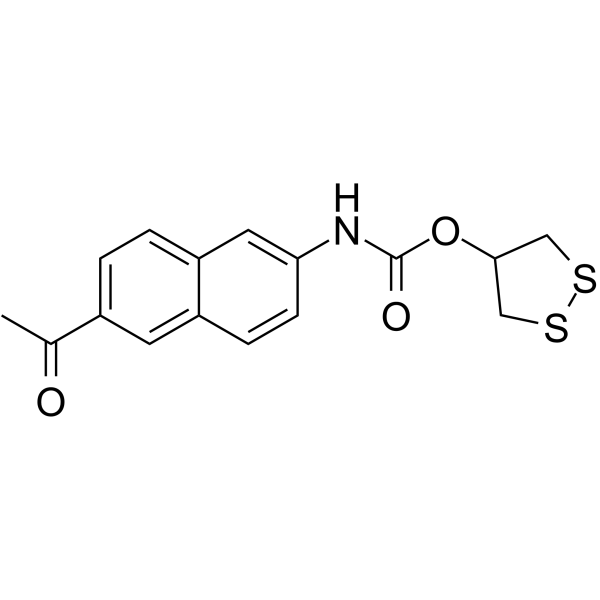
TP-TRFS is a highly selective and the first two-photon fluorescent probe of thioredoxin reductase (TrxR) .
loading...
    loading...
Cat. No.: HY-136675
CAS No.: 1850419-05-4
Target:  

Fluorescent Dye

Research Areas:  

Others

ASMI is a ratiometric, two-photon excited fluorescent probe, composed of a highly two-photon active and biocompatible merocyanine fluorophore and an acrylate moiety as a thiol reactive site. ASMI is able to selectively detect and monitor mitochondrial Cys with rapid responsiveness, imaging living cells and intact tissues with high contrast and brightness at a depth of 150 μm. The two-photon action cross section (Φσmax) of ASMI is 65.2 GM, corresponding to an excitation wavelength (λex) of 740 nm.
loading...
    loading...
Cat. No.: HY-D2474
CAS No.: 3030735-86-2
PSP is a two-photon fluorescent probe for selective and sensitive detection of H2Sn in live cells and tumor spheroids (Ex/Em = 440/640 nm). PSP can be utilized in ferroptosis research .
loading...
    loading...
Cat. No.: HY-D2968
CAS No.: 2759816-87-8
Target:  

Fluorescent Dye

Research Areas:  

Neurological Disease

DCM-ONOO is a near-infrared two-photon fluorescence probe specifically designed for real-time monitoring of the dynamic fluctuations of peroxynitrite (ONOO⁻) in epilepsy models. DCM-ONOO exhibits excellent optical properties, with a single photon excitation (Ex) of 520 nm; a single photon emission (Em) of 685 nm; a two-photon excitation of 820 nm; and a Stokes shift of 165 nm. When DCM-ONOO is combined with ONOO⁻, it shifts from 460 nm to 512 nm, and only generates a significant fluorescence response to ONOO⁻. DCM-ONOO has been successfully applied to rat epilepsy models .
loading...
    loading...
Cat. No.: HY-D2376
BH-Vis is a two-photon fluorescent probe that inhibits cell plasma membrane (CPM). BH-Vis has great potential to accurately identify pyroptosis at the cellular level during AAA development in the mouse abdominal aortic aneurysm AAA model .
loading...
    loading...
Cat. No.: HY-D3267
CAS No.: 1314527-28-0
ACu1 is a copper (I)-selective two-photon fluorescent probe that enables the visual imaging of Cu + distribution in living cells and tissues .
loading...
    loading...
Cat. No.: HY-D3171
AD-BChE/HClO is a dual-target two-photon fluorescent probe. AD-BChE/HClO produces strong fluorescence only in the simultaneous presence of BChE and HClO. AD-BChE/HClO enables two-photon imaging in nerve cells and mouse brain tissues via tail vein injection. AD-BChE/HClO can be used for the research of Alzheimer's disease (Ex/Em = 450 nm/500 nm) .
loading...
    loading...
Cat. No.: HY-161476
Target:  

Fluorescent Dye

Research Areas:  

Cancer

Ir-ImNO is a mitochondria-targeted two-photon probe with excellent cell membrane permeability, capable of detecting both endogenous and exogenous cell membrane permeability. Ir-ImNO can monitor different immune response states of macrophages through various imaging techniques, including one-photon and two-photon phosphorescence imaging as well as phosphorescence lifetime imaging. Ir-ImNO can be utilized in the research to assist in the clinical monitoring of immunotherapy .
loading...
    loading...
Cat. No.: HY-D3221
CAS No.: 1386860-79-2
MAO Probe 1 is a reactive two-photon fluorescent probe capable of crossing the blood-brain barrier, which is used to detect the activity of monoamine oxidases (MAO-A/MAO-B), with Km values of 70 μM (MAO-A) and 75 μM (MAO-B), respectively. IBC 2 (benzo[g]imino-coumarin 2), the enzymatic product of MAO Probe 1, can further specifically bind to and image Aβ plaques, enabling in vivo two-photon co-monitoring of MAO activity and Aβ plaques. MAO Probe 1 can be used in Alzheimer's disease research (IBC 2: Ex/Em = 850 nm/570-620 nm) .
loading...
    loading...
Cat. No.: HY-D3087
CAS No.: 1966158-27-9
Target:  

Fluorescent Dye

Research Areas:  

Cancer

Lyso-OC is a two-photon fluorescent probe that enables real-time monitoring of autophagy through ultrasensitive detection of lysosomal polarity changes. Lyso-OC possesses a coumarin (HY-N0709) solvatochromic group and a morpholine lysosome-targeting group, allowing selective lysosomal localization in living cells. Lyso-OC emits strong fluorescence in low-polarity lysosomes, whereas in high-polarity autolysosomes formed during autophagy, its fluorescence intensity decreases and the emission peak shifts by approximately 30 nm. For two-photon detection, the excitation/emission wavelengths of Lyso-OC are 760/490-550 nm, and its one-photon excitation wavelength is 375 nm. Lyso-OC can be used in cancer-related research .
loading...
    loading...
Cat. No.: HY-D3131
CAS No.: 2243068-74-6
Target:  

Fluorescent Dye

Research Areas:  

Others

Lyso-MPCB is a two-photon fluorescent probe used for lysosomal pH detection and autophagy monitoring. Lyso-MPCB integrates a benzimidazole pH-responsive group and a morpholine lysosome-targeting group, enabling specific localization to lysosomes. The fluorescence properties of Lyso-MPCB change with protonation, exhibiting blue fluorescence under alkaline conditions and green fluorescence under acidic conditions .
loading...
    loading...
Cat. No.: HY-D3073
CAS No.: 2477607-64-8
Target:  

Fluorescent Dye

Research Areas:  

Others

DXB-NIR is a push-pull dioxaboron fluorescent probe with solvatochromic properties, featuring high fluorescence brightness, photostability, and a large two-photon absorption cross-section. DXB-NIR exhibits Ex/Em of 550/620–780 nm (with two-photon excitation at 930 nm). DXB-NIR quantifies local polarity via the intensity ratio I (>640)/I (<640) between the far-red channel (<640 nm) and the near-infrared channel (>640 nm), and it can simultaneously label the plasma membrane, endoplasmic reticulum, and lipid droplets in live cells. DXB-NIR monitors the increase in local polarity of various cell compartments under conditions of cholesterol depletion, starvation, and oxidative stress. DXB-NIR can be used for polarity imaging of biological membranes and lipid droplets, as well as studies related to cellular stress .
loading...
    loading...
Cat. No.: HY-D3173
CAS No.: 1708978-54-4
Synonyms: TPG-456
TP-α (TPG-456) is a glucagon-selective two-photon fluorescent probe with a Kd of 65 μM. TP-α directly interacts with glucagon to produce significant fluorescence enhancement. TP-α selectively stains viable glucagon-secreting α cells in pancreatic islets, enabling visualization of their localization, distribution and availability. TP-α is applicable to diabetes research (Ex/Em = 370nm/510 nm) .
loading...
    loading...
Cat. No.: HY-D3166
CAS No.: 2413816-64-3
CEMT is a carboxylesterase (CES) substrate and a ratiometric two-photon fluorescent reporter probe. CEMT can be hydrolyzed by CES to generate HMT, which is used for mitochondrial pH sensing. After activation by CES, CEMT exhibits ratiometric fluorescence changes in response to pH variations. CEMT targets and covalently binds to mitochondria, and can avoid leakage during acidification, thus enabling in situ imaging (Ex/Em = 410 nm/550 nm) .
loading...
    loading...
Cat. No.: HY-D3196
CAS No.: 1198157-60-6
AG2 is a glucose uptake tracer and two-photon fluorescent probe. AG2 is taken up by cells via glucose-specific transport systems, rather than passive diffusion; it preferentially accumulates in cancer cells and colon cancer tissues compared with normal cells and tissues; it mainly localizes to mitochondria, with a small amount also distributed in the cytoplasm and cell membrane. AG2 can be used for colon cancer research .
loading...
    loading...

