



Human β-defensin-2

Based on 1 Customer Validation
Human β-defensin-2 (HβD-2) is an orally active, cysteine-rich antimicrobial peptide secreted by epithelial cells, with antibacterial, antiviral, and immunomodulatory activities. Human β-defensin-2 binds to CCR2, reduces NF-κB phosphorylation, increases CREB phosphorylation, inhibits pro-inflammatory cytokines, induces IL-10, and chemotaxes immune cells through CCR2/CCR6. Human β-defensin-2 reduces smoke-induced neutrophil influx in mouse lungs, downregulates pulmonary pro-inflammatory signaling, promotes bacterial clearance, and improves colitis and asthma cytokine/lung resistance. Human β-defensin-2 can be used in research related to diseases such as inflammatory bowel disease, bacterial infections, viral infections, and atopic asthma.
For research use only. We do not sell to patients.
- Purity : 98.22%
- CAS No.: 372146-20-8
- Formula: C188H305N55O50S6
- Molecular Weight:4328.20
-
Storage:
Sealed storage, away from moisture.
Powder -80°C, 2 years , -20°C, 1 year* In solvent : -80°C, 6 months; -20°C, 1 month (sealed storage, away from moisture)

To place orders, for customer services and technical support, please contact: MedChemExpress USA
Tel: 609-228-6898 E-mail: [email protected] [email protected]


-
 Biological Activity
-
Chemical Information
-
Solvent & Solubility
- Protocols
- Purity & Documentation
- References
-
 Help & FAQs


All Antibiotic Isoforms
More

Biological Activity
Description
|
NF-κB |
TNF-α |
IL-10 |
IL4 |
IL-5 |
IL-6 |
IL-13 |
In Vitro
Human β-defensin-2 (10-100 µg/mL; 24 h) attenuates LPS-induced TNF-α production in human Mo-DCs in a CCR2-dependent manner, and modulates cytokine secretion, NF-κB/CREB signaling, and maturation in mouse BM-DCs[1].
MedChemExpress (MCE) has not independently confirmed the accuracy of these methods. They are for reference only.
-
Cell Line:human mo-DCs and murine BM-DCs
-
Concentration:10, 100 µg/mL
-
Incubation Time:24 h
-
Result:Dose-dependently curbed LPS-induced TNF‑α secretion in human mo-DCs and murine BM-DCs, and its immunomodulatory effect relies on TLR and CCR2 signaling.
In Vivo
Human β-defensin-2 (0.1 mg/kg; s.c.; once daily; starting on day 0 after colitis induction) ameliorates TNBS colitis in BALB/cByJ mice, reducing colon weight and macroscopic and microscopic colon pathology[1].
Human β-defensin-2 (1.2 mg/kg/day; intranasal or intragastric; daily; for 4 days) attenuates acute cigarette smoke-induced pulmonary neutrophilia and lung neutrophil percentage when administered locally or systemically, without affecting macrophage, dendritic cell, or lymphocyte populations[3].
MedChemExpress (MCE) has not independently confirmed the accuracy of these methods. They are for reference only.
-
Animal Model:C57BL/6 (male, 7-8 weeks old, nduced by supplementing the drinking water with 2% dextran sodium sulfate for 7 days)[1]
-
Dosage:0.1 mg/kg
-
Administration:s.c.; once a day; starting at day 1 until day 10
-
Result:Prevented excessive weight loss and improved the DAI.
Scoring of the colonic mucosa for damage revealed significantly reduced mucosal damage in mice given hBD2.
Histological assessment showed hBD2 prevented this loss of crypts and maintained a normal mucosa, comparable to naïve mice.
-
Animal Model:BALB/cByJ (male, induced on day 0 by intracolonic (distal) administration of trinitrobenzene sulfonic acid (1 mg in 50% ethanol) under mild anesthesia)[1]
-
Dosage:0.1 mg/kg
-
Administration:s.c.; once a day; starting on day 0 after colitis induction
-
Result:Mice receiving hBD2 trended toward increased weight gain from day 1-7.
s.c. hBD2 significantly reduced colon weight.
s.c. hBD2 significantly improved the macroscopic and microscopic scores of mouse colons.
Microscopic analysis showed that mice receiving hBD2 had a nearly normal mucosa.
-
Animal Model:C.B-17 SCID (female recipient, 8 weeks old, injected 500,000 CD4+/CD25− cells (in a final volume of
0.2 ml RPMI 1640 (HY-K3004))[1] -
Dosage:0.1 mg/kg and 1 mg/kg
-
Administration:s.c.; once daily; starting 7 days post T cell transfer for 86 days
-
Result:Colitis mice given 1 mg/kg hBD2 s.c. showed less weight loss, improved DAI, and improved stool score compared with the T cell colitis control group.
1 mg/kg hBD2 significantly reduced colon weight.
Only a minor effect of hBD2 on colonic myeloperoxidase activity was observed.
Histological analysis showed less inflammation and tissue disruption in mice given 1 mg/kg hBD2.
The 0.1 mg/kg dose did not improve the outcome of T cell mediated colitis.
-
Animal Model:BALB/c (female, 7-8 weeks of age)[5]
-
Dosage:0.4 mg/kg per dose
-
Administration:p.o.; days 12 and 13: three times daily; day 14: two doses, last dose 1 h before HDM challenge; days 12-14
-
Result:Reduced HDM-triggered lung resistance and lung tissue TNF-α, IL-4, IL-5, IL-6, IL-9, IL-13 secretion in mice; spared IL-33.
Did not alter BALF total/differential cell counts, and impaired lung compliance at high methacholine doses.
- Kinase activity and phosphorylation assays
- Phagocytosis Functional Assay
- Research Protocol for Infectious Diseases
- Western Blot
- LPS-Induced Endotoxemia/Systemic Inflammation
- DSS-Induced Colitis
- TNBS-Induced Colitis
- Protocol for Pharmacokinetic Study
- Research Protocol for Inflammation-related Diseases
- Protocol for Kinase activity and phosphorylation assays


Chemical Information
-
CAS No. 372146-20-8
-
Appearance Solid
-
Molecular Weight 4328.20
-
Formula C188H305N55O50S6
-
Color White to off-white
-
Synonyms
HβD-2
-
Sequence
Gly-Ile-Gly-Asp-Pro-Val-Thr-Cys-Leu-Lys-Ser-Gly-Ala-Ile-Cys-His-Pro-Val-Phe-Cys-Pro-Arg-Arg-Tyr-Lys-Gln-Ile-Gly-Thr-Cys-Gly-Leu-Pro-Gly-Thr-Lys-Cys-Cys-Lys-Lys-Pro (Disulfide bridge:Cys8-Cys37; Cys15-Cys30; Cys20-Cys38)
-
Sequence Shortening
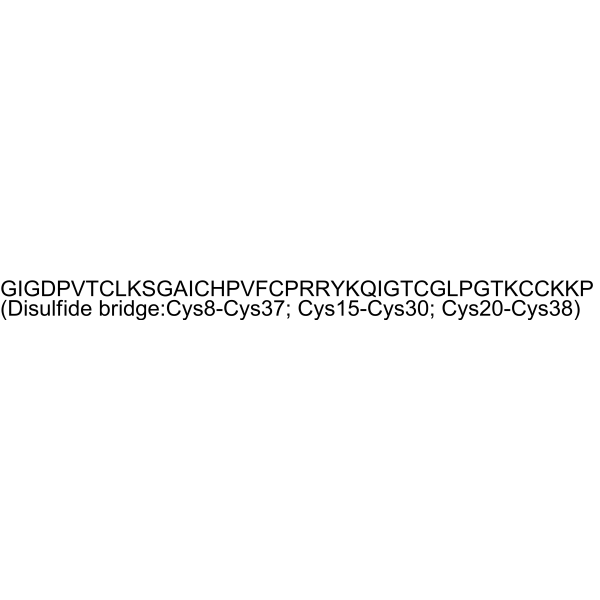
GIGDPVTCLKSGAICHPVFCPRRYKQIGTCGLPGTKCCKKP (Disulfide bridge:Cys8-Cys37; Cys15-Cys30; Cys20-Cys38)
-
Shipping
Room temperature in continental US; may vary elsewhere.
-
Storage
Sealed storage, away from moisture
Powder -80°C 2 years -20°C 1 year * In solvent : -80°C, 6 months; -20°C, 1 month (sealed storage, away from moisture)


Solvent & Solubility
In Vitro:
DMSO : ≥ 50 mg/mL (11.55 mM; Hygroscopic DMSO has a significant impact on the solubility of product, please use newly opened DMSO)
* "≥" means soluble, but saturation unknown.
Please refer to the solubility information to select the appropriate solvent. Once prepared, please aliquot and store the solution to prevent product inactivation from repeated freeze-thaw cycles.
Storage method and period of stock solution: -80°C, 6 months; -20°C, 1 month (sealed storage, away from moisture). When stored at -80°C, please use it within 6 months. When stored at -20°C, please use it within 1 month.
Concentration (start) × Volume (start) = Concentration (final) × Volume (final)


Purity & Documentation
-
Data Sheet (334 KB)
-
SDS (254 KB)
- English - EN (254 KB)
- Français - FR (254 KB)
- Deutsch - DE (254 KB)
- Norwegian - NO (254 KB)
- Español - ES (254 KB)
- Swedish - SV (254 KB)
- Italian - IT (254 KB)
- Korean - KR (254 KB)
- Portuguese - PT (254 KB)
-
Handling Instructions (2659 KB)
References


Complete Stock Solution Preparation Table
Please refer to the solubility information to select the appropriate solvent. Once prepared, please aliquot and store the solution to prevent product inactivation from repeated freeze-thaw cycles.
Storage method and period of stock solution: -80°C, 6 months; -20°C, 1 month (sealed storage, away from moisture). When stored at -80°C, please use it within 6 months. When stored at -20°C, please use it within 1 month.
| Optional Solvent | Concentration Solvent Mass | 1 mg | 5 mg | 10 mg | 25 mg |
|---|---|---|---|---|---|
| DMSO | 1 mM | 0.2310 mL | 1.1552 mL | 2.3104 mL | 5.7761 mL |
| 5 mM | 0.0462 mL | 0.2310 mL | 0.4621 mL | 1.1552 mL | |
| 10 mM | 0.0231 mL | 0.1155 mL | 0.2310 mL | 0.5776 mL |


Human β-defensin-2 Related Classifications
HY-P2313 Related Classifications
 Powered by Bioz