23 Results for "

CDK1 phosphorylation

" in MedChemExpress (MCE) Product Catalog:
Products (23)

23 Results for "CDK1 phosphorylation" in MCE Product Catalog:

8
8 Publications Verification
Cat. No.: HY-111388A
CAS No.: 2443816-41-7
Purity:  99.29%
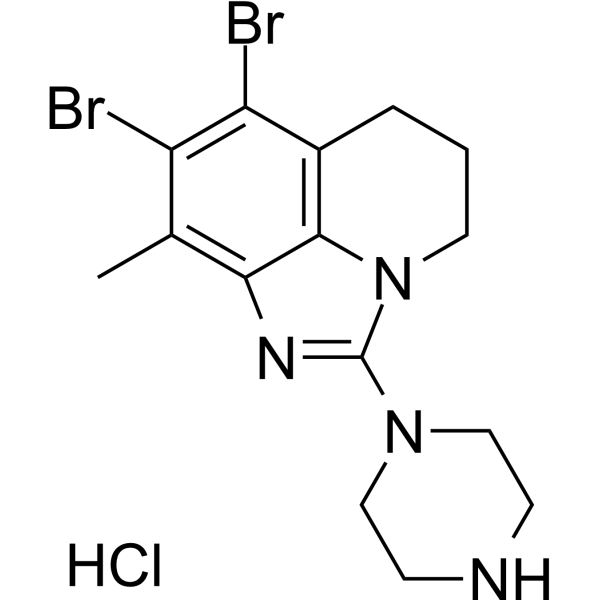
Synonyms: SEL120-34A monohydrochloride
Target:  

CDK

Research Areas:  

Cancer

SEL120-34A monohydrochloride is an ATP-competitive and selective CDK8 inhibitor, inhibits kinase activities of CDK8/CycC and CDK19/CycC complexes with IC50s of 4.4 nM and 10.4 nM, respectively, with a Kd of 3 nM for CDK8. SEL120-34A monohydrochloride weakly inhibits CDK9 (calculated IC50=1070 nM), but shows no obvious activity against CDK1, 2, 4, 6, 5, 7. SEL120-34A monohydrochloride inhibits phosphorylation of STAT1 S727 and STAT5 S726 . Has anti-tumor activity .
loading...
    loading...
4
4 Cited Publications
Cat. No.: HY-11001
CAS No.: 718630-59-2
Purity:  99.25%
Target:  

CDK Caspase Apoptosis GSK-3

Research Areas:  

Cancer

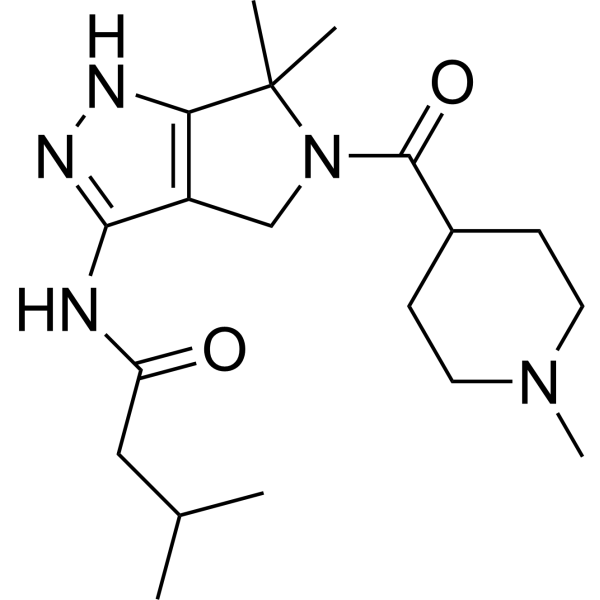
PHA-793887 is a CDK inhibitor (with IC50 values of 8 nM for Cdk2, 60 nM for Cdk1, 62 nM for Cdk4, 138 nM for Cdk9). PHA-793887 inhibits purified GSK3β (IC50 79 nM). PHA-793887 reduces the phosphorylation level of nucleophosmin/cdc6, induces G1/G2/M phase arrest, and triggers Apoptosis by activating Caspase-3. PHA-793887 exhibits anticancer activity against leukemia. PHA-793887 can be used in research related to acute leukemia, chronic myeloid leukemia, and advanced/metastatic solid tumors .
loading...
    loading...
2
2 Cited Publications
Cat. No.: HY-12445
CAS No.: 1421693-22-2
Purity:  99.18%
Synonyms: CDKI-73; LS-007
Target:  

CDK Apoptosis

Research Areas:  

Inflammation/Immunology Cancer

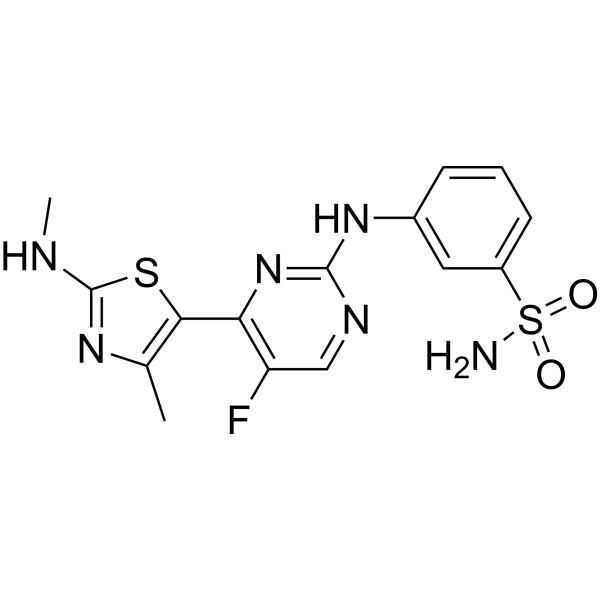
Asnuciclib (CDKI-73; LS-007) is an orally active and highly efficacious CDK9 inhibitor, with Ki values of 4 nM, 4 nM and 3 nM for CDK9, CDK1 and CDK2, respectively. Asnuciclib down-regulates the RNAPII phosphorylation. Asnuciclib is also a novel pharmacological inhibitor of Rab11 cargo delivery and innate immune secretion .
loading...
    loading...
1
1 Cited Publications
Cat. No.: HY-158106
CAS No.: 3047321-53-6
Purity:  99.60%
Synonyms: AZD8421
Target:  

CDK

Research Areas:  

Cancer

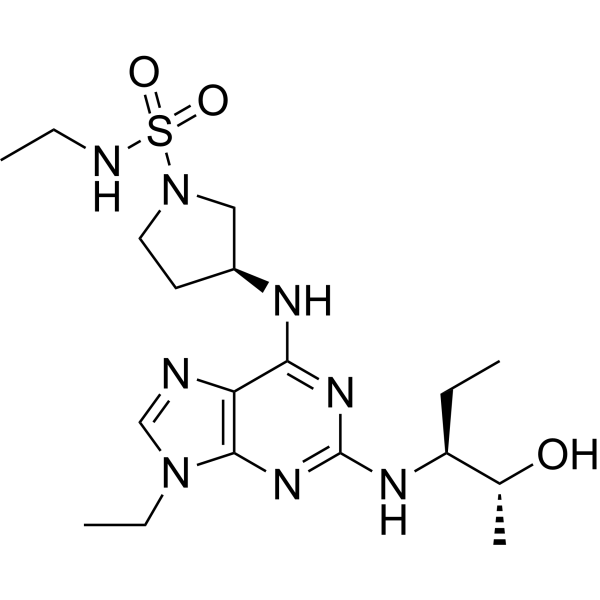
Gatsuciclib (AZD8421) is a selective CDK2 inhibitor (IC50 = 9 nM) as well as achieving CDK family selectivity in cells versus key off-targets (CDK1, CDK4/6, CDK9). Gatsuciclib has no significant kinase inhibition outside the CDK family. Gatsuciclib inhibits cancer cell proliferation by inhibiting pRB phosphorylation, inducing cell cycle arrest in G1/S phase and senescence. Gatsuciclib can be studied in research for breast cancer and ovarian cancer .
loading...
    loading...
Cat. No.: HY-N12625
CAS No.: 1364123-68-1
(R)-(+)-O-Demethylbuchenavianine is an inhibitor for Cyclin-dependent kinases (CDK). (R)-(+)-O-Demethylbuchenavianine inhibits CDK1, CDK5, glycogen synthase kinase-3 (GSK3), cdc2-like kinase (CLK1) and dual specificity tyrosine-phosphorylation-regulated kinase 1A (DYRK1A), with IC50s of 1.1, 0.95, >10, >10 and >10 μM, respectively .
loading...
    loading...
Cat. No.: HY-N11439
CAS No.: 87084-99-9
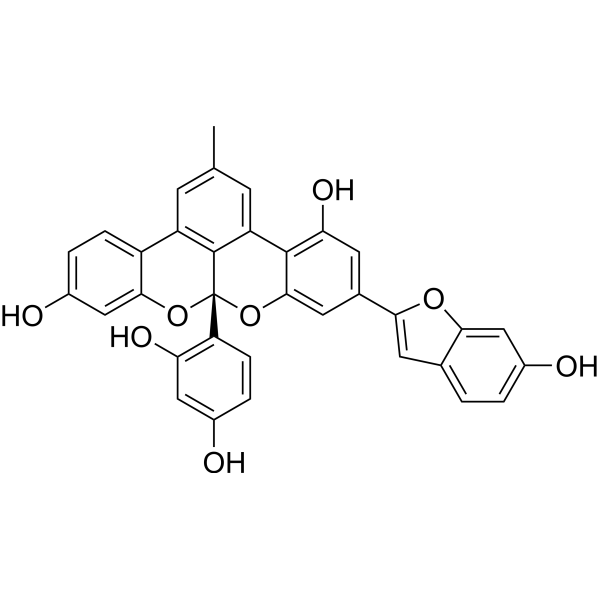
Albanol B is an arylbenzofuran derivative which can be isolated from mulberries. Albanol B exhibits anti-Alzheimer's disease, anti-bacterial and antioxidant activities. Albanol B inhibits cancer cells proliferation, down-regulates CDK1 expression. Albanol B also induces cell cycle arrest at G2/M and apoptosis. And Albanol B induces mitochondrial ROS production and increases the phosphorylation levels of AKT and ERK1/2 .
loading...
    loading...
Cat. No.: HY-123034
CAS No.: 1189558-88-0
Target:  

CDK Bcl-2 Family Apoptosis

Research Areas:  

Cancer

CDKI-83 is a potent CDK9 and CDK1 inhibitor with Ki values of 21 nM and 72 nM for CDK9/T1 and CDK1/B, respectively. CDKI-83 demonstrates effective anti-proliferative activity in human tumour cell lines with a GI50<1 μM. CDKI-83 effectively induces apoptosis in A2780 human ovarian cancer cells. CDKI-83 reduces phosphorylation at Ser-2 of RNA polymerase II (RNAPII) by inhibiting cellular CDK9 activity, and down-regulates Mcl-1 and Bcl-2. CDKI-83 has the potential for anti-cancer research .
loading...
    loading...
Cat. No.: HY-159937
CAS No.: 2986404-30-0
Target:  

Wee1 CDK

Research Areas:  

Cancer

PKMYT1-IN-7 (compound 7) is an orally active PKMYT1 inhibitor with IC50 values of 1.6 nM and 0.06 μM against of PKMYT1 and pCDK1, respectively. PKMYT1-IN-7 suppresses the phosphorylation of CDK1 at T14 and Y15. PKMYT1-IN-7 shows anticancer activity both < and < .
loading...
    loading...
Cat. No.: HY-121989
CAS No.: 94608-23-8
Purity:  ≥98.0%
Synonyms: (Z)-3,5,4'-Trimethoxystilbene
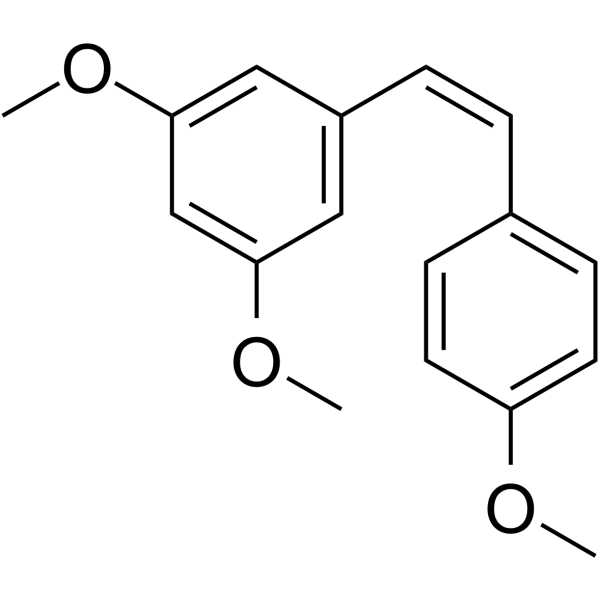
cis-Trismethoxy resveratrol ((Z)-3,5,4'-Trimethoxystilbene) is an anti-HCV agent and Tubulin inhibitor, with an IC50 of 4 μM against Tubulin. cis-Trismethoxy resveratrol induces G2/M phase cell cycle arrest, reduces DCLK1, decreases CDK1 levels, blocks phosphorylation of Akt Ser 473, and induces the expression of p21 Cip1/Waf1. cis-Trismethoxy resveratrol exhibits anti-tumor and hepatoprotective activities. cis-Trismethoxy resveratrol can be used in studies related to colon adenocarcinoma, hepatocellular carcinoma, hepatitis C, and liver injury .
loading...
    loading...
Cat. No.: HY-189676
PKMYT1-IN-16 is an orally active and selective PKMYT1 kinase inhibitor with IC50 = 2.3 nM. PKMYT1-IN-16 blocks CDK1 inhibitory phosphorylation and reduces CDK1 phosphorylation, and inhibits DDR1, EPHA2, SRC, and CSF1R. PKMYT1-IN-16 in combination with CHK1 inhibitors exhibits synergistic antiproliferative activity, disrupts cell cycle checkpoints, aggravates DNA damage, and induces apoptosis (apoptosis). PKMYT1-IN-16 can be used for research on triple-negative breast cancer (TNBC) and ovarian cancer .
loading...
    loading...
Cat. No.: HY-182906
CAS No.: 3040320-93-9
Target:  

Wee1 CDK

Research Areas:  

Cancer

XL495 is an potent, selective and orally active PKMYT1 inhibitor. XL495 inhibits CDK1 Thr14 phosphorylation and induces KAP1 Ser824 phosphorylation in xenograft tumors. XL495 reduces tumor growth in colorectal and breast cancer xenograft models, and achieves tumor regression with DNA-damaging agents in colorectal cancer xenograft models. XL495 can be used for the research of cancer, such as breast cancer and colorectal cancer .
loading...
    loading...
Cat. No.: HY-189307
Target:  

Wee1 CDK DNA/RNA Synthesis

Research Areas:  

Cancer

WEE1-IN-15 is an ATP-competitive, selective WEE1 kinase inhibitor (IC50: 42 nM). WEE1-IN-15 abolishes CDK1 phosphorylation. WEE1-IN-15 induces DNA damage and replication stress, and increases the S-phase cell population. WEE1-IN-15 shows selective anticancer effects on colorectal cancer organoids .
loading...
    loading...
Cat. No.: HY-180484
CAS No.: 2974454-59-4
Research Areas:  

Cancer

PKMYT1-IN-12 (Compound 4) is a selective inhibitor of PKMYT1, with an IC₅₀ of 2.6 nM. PKMYT1-IN-12 can effectively inhibit the phosphorylation of CDK1, with an IC₅₀ of 44 nM. PKMYT1-IN-12 is a target protein ligand that can be used for the synthesis of PROTAC D16-M1P2 (HY-180485) .
loading...
    loading...
Cat. No.: HY-184307
Target:  

FAK CDK DNA/RNA Synthesis

Research Areas:  

Cancer

FAK1/2 Ligand-1 is a FAK1/FAK2 ligand with KD values of 2.9 μM and 2.5 μM for binding to FAK1 and FAK2, respectively. FAK1/2 Ligand-1 induces G2/M phase arrest, activates DNA damage-related signaling pathways, and reduces the phosphorylation level of CDK1. Antitumor agent-220 is applicable to the research of triple-negative breast cancer .
loading...
    loading...
Cat. No.: HY-183547
CAS No.: 3055032-68-0
Target:  

Wee1 CDK

Research Areas:  

Cancer

WEE1/PKMYT1-IN-4 is a selective WEE1/PKMYT1 inhibitor, with IC50 values of 0.185 μM and 2.2 nM for human WEE1 and PKMYT1, respectively. WEE1/PKMYT1-IN-4 inhibits phosphorylation of CDK1 at T14 and Y15, disrupting the G2/M cell cycle checkpoint. WEE1/PKMYT1-IN-4 can be used for the research of colorectal cancer and amplified breast cancer .
loading...
    loading...
Cat. No.: HY-187562
Target:  

Wee1 CDK

Research Areas:  

Cancer

PKMYT1-IN-15 is an orally active PKMYT1 inhibitor with an IC50 of 6.02 nM. PKMYT1-IN-15 inhibits the phosphorylation of CDK1 at Thr14. As an antiproliferative agent, DNA damage inducer and antitumor agent, PKMYT1-IN-15 triggers replication-associated DNA damage and cell death in CCNE1-amplified cancer cells, and suppresses tumor growth in the OVCAR3 xenograft model. PKMYT1-IN-15 can be used for the research of CCNE1-amplified cancers (e.g., ovarian cancer, breast cancer) .
loading...
    loading...
Cat. No.: HY-208742
CAS No.: 2414418-56-5
ZNL-02-096 is a selective Wee1 PROTAC degrader. ZNL-02-096 binds to CRBN and Wee1 to form a ternary complex, inducing CRBN- and proteasome-dependent ubiquitination and proteasomal degradation of Wee1. ZNL-02-096 inhibits recombinant PLK1 with an IC50 of 102 nM, but does not induce its degradation in cells. ZNL-02-096 induces G2/M phase arrest, Apoptosis, transient integrated stress response, upregulation of ATF4, and phosphorylation of GCN2. ZNL-02-096 reduces Tyr15 phosphorylation of CDK1. ZNL-02-096 can be used in research related to ovarian cancer, acute lymphoblastic leukemia, triple-negative breast cancer, multiple myeloma, and pancreatic ductal adenocarcinoma .
loading...
    loading...
Cat. No.: HY-11001A
CAS No.: 718630-60-5
Target:  

CDK Caspase Apoptosis GSK-3

Research Areas:  

Cancer

PHA-793887 hydrochloride is a CDK inhibitor (with IC50 values of 8 nM for Cdk2, 60 nM for Cdk1, 62 nM for Cdk4, 138 nM for Cdk9). PHA-793887 hydrochloride inhibits purified GSK3β (IC50 79 nM). PHA-793887 hydrochloride reduces the phosphorylation level of nucleophosmin/cdc6, induces G1/G2/M phase arrest, and triggers Apoptosis by activating Caspase-3. PHA-793887 hydrochloride exhibits anticancer activity against leukemia. PHA-793887 hydrochloride can be used in research related to acute leukemia, chronic myeloid leukemia, and advanced/metastatic solid tumors .
loading...
    loading...
Cat. No.: HY-183073
Research Areas:  

Cancer

TZ1104 is a PROTAC-based CDK7 degrader, with a DC50 of 0.88 nM. TZ1104 forms a ternary complex with VHL E3 ligase and CDK7 to trigger proteasome-dependent CDK7 degradation, destabilizing the CDK7-cyclin H-MAT1 complex. TZ1104 suppresses phosphorylation of RNA polymerase II CTD Ser5, CDK1 Thr161, and CDK2 Thr160. TZ1104 activates the p53-p21 axis and suppresses oncogenic Myc signaling. TZ1104 induces cell cycle arrest, apoptosis, and differentiation of acute leukemia cells. TZ1104 can be used for the research of acute leukemia .

loading...
    loading...
Cat. No.: HY-111388AR
CAS No.: 2443816-41-7
Synonyms: SEL120-34A monohydrochloride (Standard)
Target:  

Reference Standards CDK

Research Areas:  

Cancer

Romaciclib monohydrochloride (Standard) is the analytical standard of Romaciclib (monohydrochloride) (HY-111388A). This product is intended for research and analytical applications. SEL120-34A monohydrochloride is an ATP-competitive and selective CDK8 inhibitor, inhibits Kinase activities of CDK8/CycC and CDK19/CycC complexes with IC50s of 4.4 nM and 10.4 nM, respectively, with a Kd of 3 nM for CDK8. SEL120-34A monohydrochloride weakly inhibits CDK9 (calculated IC50=1070 nM), but shows no obvious activity against CDK1, 2, 4, 6, 5, 7. SEL120-34A monohydrochloride inhibits phosphorylation of STAT1 S727 and STAT5 S726 . Has anti-tumor activity .
loading...
    loading...

