

12 Results for "

FcRn binding

" in MedChemExpress (MCE) Product Catalog:
Products (12)

12 Results for "FcRn binding" in MCE Product Catalog:

3
3 Cited Publications
Cat. No.: HY-P99037
CAS No.: 2211985-36-1
Synonyms: M281

Target:  

Fc Receptor (FcR)

Research Areas:  

Inflammation/Immunology

Nipocalimab (M281) is a fully humanized, recombinant, and non-glycosylated IgG1 monoclonal antibody. Nipocalimab can bind to the IgG-binding site of FcRn with high affinity and inhibit the transplacental transfer of IgG. Nipocalimab can be used in the research of fetal and neonatal hemolytic disease, myasthenia gravis, and various IgG-mediated autoimmune diseases .
loading...
    loading...
Cat. No.: HY-P99009
CAS No.: 2187430-05-1
Synonyms: RVT-1401; HBM9161; IMVT-1401

Target:  

Fc Receptor (FcR)

Research Areas:  

Inflammation/Immunology

Batoclimab (RVT-1401) is a fully humanized IgG1 monoclonal antibody targeting FcRn. Batoclimab has high affinity for the IgG-binding site on FcRn. By competitively binding to the IgG binding site on FcRn, Batoclimab blocks FcRn-mediated recycling of IgG, resulting in enhanced degradation and subsequent reductions in IgG levels. Batoclimab can be used in the research of autoimmune diseases such as myasthenia gravis and thyroid eye disease .
loading...
    loading...
Cat. No.: HY-P990818

Target:  

Fc Receptor (FcR)

Research Areas:  

Inflammation/Immunology

Anti-Rat FcRn heavy chain heterodimers Antibody (1G3) is an anti-rat FcRn heavy chain heterodimers IgG1 monoclonal antibody. Anti-Rat FcRn heavy chain heterodimers Antibody (1G3) can effectively bind to FcRn and competitively inhibit the binding of IgG to FcRn. Anti-Rat FcRn heavy chain heterodimers Antibody (1G3) can reduce the total serum IgG level. Anti-Rat FcRn heavy chain heterodimers Antibody (1G3) can be used for researches on autoimmune conditions such as experimental autoimmune myasthenia gravis (EAMG). The recommend isotype control of Anti-Rat FcRn heavy chain heterodimers Antibody (1G3): Mouse IgG1 kappa, Isotype Control (HY-P99977) .
loading...
    loading...
Cat. No.: HY-145775
CAS No.: 1425051-22-4
Target:  

Fc Receptor (FcR)

Research Areas:  

Inflammation/Immunology

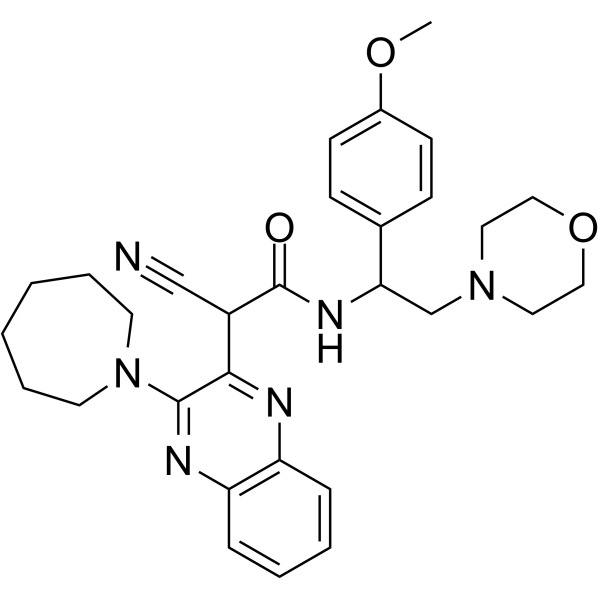
hIgG-hFc receptor-IN-1 is a quinoxaline-based human immunoglobulin G-human neonatal Fc receptor (hIgG-hFcRn) protein-protein interaction inhibitor with an IC50 of 2 μM. hIgG-hFc receptor-IN-1 blocks the binding of hIgG to human FcRn. hIgG-hFc receptor-IN-1 can be used for immune-related research .
loading...
    loading...
Cat. No.: HY-P990244

Target:  

Fc Receptor (FcR)

Research Areas:  

Inflammation/Immunology

Anti-Rat FcRn heavy chain heterodimers Antibody (2G3) is an anti-rat FcRn heavy chain heterodimers IgG1 monoclonal antibody. Anti-Rat FcRn heavy chain heterodimers Antibody (2G3) effectively inhibits the binding of FcRn to IgG. Anti-Rat FcRn heavy chain heterodimers Antibody (2G3) is used in studies of the MHC class I heavy chain FcRn heterodimers and their interaction with IgG .
loading...
    loading...
Cat. No.: HY-179609
CAS No.: 931360-60-0
Target:  

Fc Receptor (FcR)

Research Areas:  

Inflammation/Immunology

C201-0243 is a FcRn antagonist. C201-0243 exhibits antagonistic activity against IgG-FcRn binding with an IC50 of 3.439 nM. C201-0243 can be used in the research of IgG-mediated autoimmune diseases .
loading...
    loading...
Cat. No.: HY-P11786
CAS No.: 1020264-43-0
Target:  

Fc Receptor (FcR)

Research Areas:  

Inflammation/Immunology

SYN1327 is a potent monomeric cyclic competitive antagonistic peptide targeting the neonatal Fc receptor (FcRn), with a Kd of 31 nM for human FcRn at pH 6 and a Kd of 170 nM at pH 7.4. SYN1327 competitively binds to the IgG-binding site of FcRn and inhibits the binding of human IgG to FcRn. SYN1327 acts as the monomeric precursor of the dimeric peptide SYN1436 (HY-P11882). SYN1327 can be used in studies related to IgG-mediated autoimmune diseases .
loading...
    loading...
Cat. No.: HY-P11786A
Target:  

Fc Receptor (FcR)

Research Areas:  

Inflammation/Immunology

SYN1327 acetate is a potent monomeric cyclic competitive antagonistic peptide targeting the neonatal Fc receptor (FcRn), with a Kd of 31 nM for human FcRn at pH 6 and a Kd of 170 nM at pH 7.4. SYN1327 acetate competitively binds to the IgG-binding site of FcRn and inhibits the binding of human IgG to FcRn. SYN1327 acetate acts as the monomeric precursor of the dimeric peptide SYN1436 (HY-P11882). SYN1327 acetate can be used in studies related to IgG-mediated autoimmune diseases .
loading...
    loading...
Cat. No.: HY-182476
CAS No.: 1359344-58-3
Target:  

Fc Receptor (FcR)

Research Areas:  

Inflammation/Immunology

Z223-2027 is a FcRn inhibitor. Z223-2027 competitively blocks the binding of immunoglobulin G (IgG) to FcRn. Z223-2027 can be used in the research of IgG-mediated autoimmune diseases .
loading...
    loading...
Cat. No.: HY-P12128
Target:  

Fc Receptor (FcR)

Research Areas:  

Metabolic Disease

SYN1753 is a selective inhibitor of human neonatal Fc receptor (hFcRn) with a Kd value of 0.5 μM. SYN1753 binds to the albumin-binding site of hFcRn, inhibits the hFcRn-albumin interaction, and thereby suppresses FcRn-mediated transcytosis of human albumin. SYN1753 can be used in studies related to acetaminophen-induced liver injury .
loading...
    loading...
Cat. No.: HY-187394
CAS No.: 1425050-80-1
Target:  

Fc Receptor (FcR)

Research Areas:  

Inflammation/Immunology

hIgG-hFc receptor-IN-3 is a protein-protein interaction inhibitor of human immunoglobulin G-human neonatal Fc receptor (hIgG-hFcRn). Identified via virtual ligand screening and optimized through structure-activity relationship studies, hIgG-hFc receptor-IN-3 competitively inhibits the binding of IgG to FcRn, thereby accelerating the clearance of endogenous IgG. hIgG-hFc receptor-IN-3 can be used for the research of autoimmune diseases .
loading...
    loading...
Cat. No.: HY-P992474
TAVO101 is a humanized anti-TSLP antibody with an EC50 of 0.19 nM against hTSLP. TAVO101 inhibits STAT5 activation and CCL17 release. TAVO101 carries Fc region mutations that enhance its binding to FcRn while reducing its binding to FcγRI, FcγRIIIA and C1q, thereby attenuating effector functions. TAVO101 reduces the levels of inflammatory markers, cell infiltration and histopathological damage in preclinical models of asthma, psoriasis and atopic dermatitis. TAVO101 can be used for research related to asthma, psoriasis and atopic dermatitis .
loading...
    loading...
  • 1

