11 Results for "

colloidal stability

" in MedChemExpress (MCE) Product Catalog:
Products (11)

11 Results for "colloidal stability" in MCE Product Catalog:

21
21 Cited Publications
Cat. No.: HY-138300
CAS No.: 1849616-42-7
Purity:  99.93%
Research Areas:  

Others

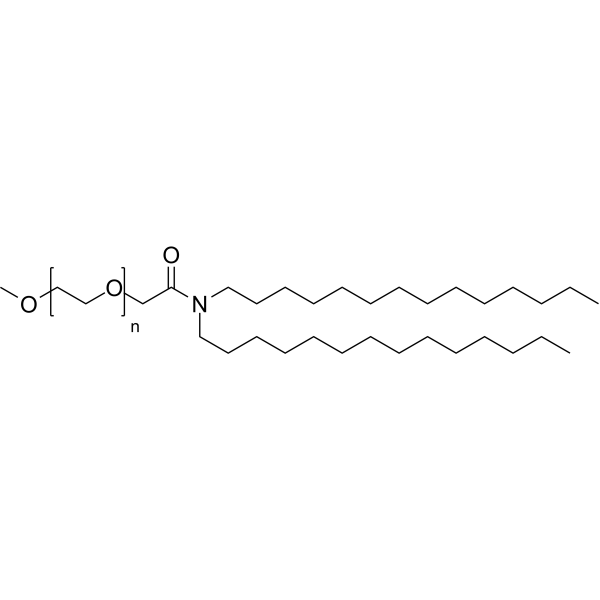
ALC-0159 presents highly mobile surface PEG chains in a dense brush-like conformation, which can form a hydrophilic barrier, reduce non-specific protein adsorption and macrophage uptake, improve colloidal stability, prolong in vivo circulation time, and affect the cellular uptake of LNPs. ALC-0159 dissociates from the surface of mRNA-LNPs under long-term mechanical oscillation stress, thereby reducing steric hindrance, inducing mRNA-LNP fusion, increasing particle size, and releasing unencapsulated mRNA .
loading...
    loading...
1
1 Cited Publications
Cat. No.: HY-W014130
CAS No.: 155-84-0
Synonyms: Ac-Arg-OH
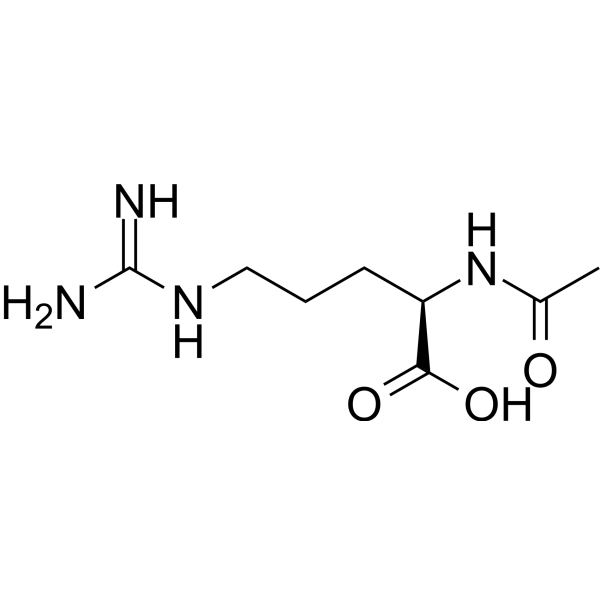
N-Acetyl-L-arginine (Ac-Arg-OH) is one of the guanidino compounds found elevated in the serum of a hemodialyzed renal insufficient (uremic) pediatric population. N-Acetyl-L-arginine shows synergistic activity with glycine buffer. N-Acetyl-L-arginine suppresses the aggregation of intravenous immunoglobulins with a minimum decrease in transition temperature. N-Acetyl-L-arginine dramatically reduces IL-1 expression in the presence of silicone oil. N-Acetyl-L-arginine also demonstrates colloidal stability .
loading...
    loading...
Cat. No.: HY-W011696
CAS No.: 112-90-3
Synonyms: cis-1-Amino-9-octadecene, 80-90%
Oleylamine, 80-90% (cis-1-Amino-9-octadecene, 80-90%) is a multifunctional reagent used for metal ion coordination and nanoparticle surface modification, and acts as a solvent, surfactant and reducing agent in the synthesis of metal oxide nanoparticles. Oleylamine, 80-90% regulates nanoparticle morphology, magnetization intensity and water proton relaxation rate via thiol-ene "click" reaction, and enhances the colloidal stability of nanoparticles in organic reagents. Oleylamine, 80-90% is mainly used in research and applications in fields such as nanomaterial synthesis, biomedical imaging (MRI contrast agents, fluorescent probes), cancer cell targeting and drug delivery .
loading...
    loading...
Cat. No.: HY-144012
CAS No.: 474922-84-4
Purity:  99.83%
Synonyms: 16:0 PEG2000 PE ammonium; 1,2-Dipalmitoyl-sn-glycero-3-phosphoethanolamine-N-[methoxy(polyethylene glycol)-2000] ammonium
Target:  

Liposome

Research Areas:  

Others

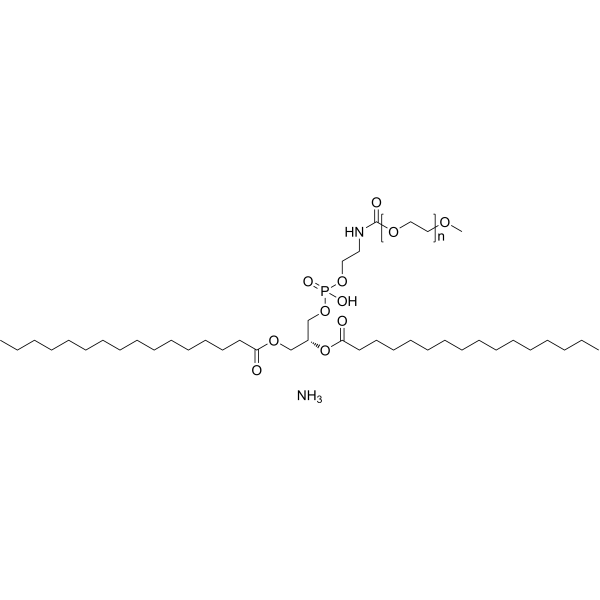
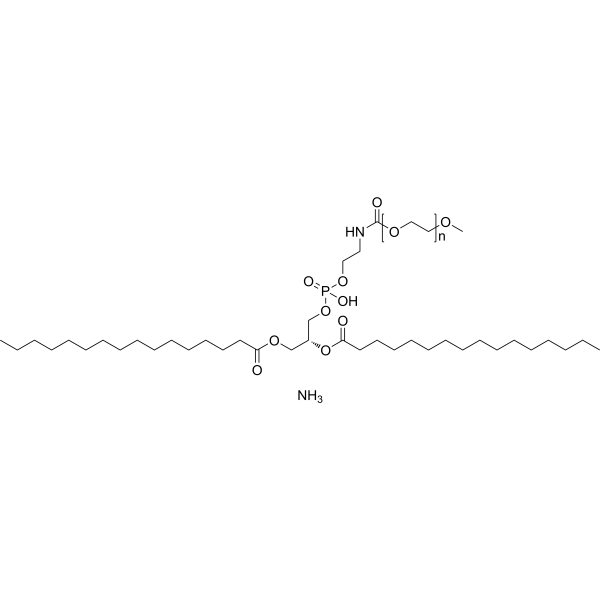
DPPE-PEG2000 ammonium (16:0 PEG5000 PE) is a polymer-lipid conjugate and LipoParticle stabilizer with a PEG chain of 5,000 g/mol molecular weight attached to its polar head, and it can be internalized by biological membranes. DPPE-PEG2000 ammonium enables LipoParticle to maintain colloidal stability after 20-fold dilution in PBS or cell culture medium, and prevents aggregate formation during lyophilization and rehydration. DPPE-PEG2000 ammonium helps enhance the non-cytotoxic property of LipoParticle formulations against human osteoblasts. DPPE-PEG2000 ammonium serves as a PEG lipid functional end group for synthesizing liposomes (LPs), is used in the design of conjugated polymer nanoparticles, and applies to research related to bone and joint infections .
loading...
    loading...
Cat. No.: HY-158082B
Synonyms: Tetramethyl rhodamine isothiocyanate glucan, MW 40000
Target:  

Fluorescent Dye

Research Areas:  

Others

TRITC-dextran (Tetramethyl rhodamine isothiocyanate glucan), MW 40000 is a TRITC (HY-D0791)-labeled neutral 40 kDa fluorescent polysaccharide probe. TRITC-dextran, MW 40000 forms a membrane layer on the surface of protocells composed of protamine/folate condensates, and is used to assess membrane fluidity via fluorescence recovery after photobleaching. TRITC-dextran, MW 40000 can also be used to evaluate the anti-bacterial invasion ability and colloidal stability of coated condensates, as well as analyze the permeability of vascular and lymphatic endothelial cell layers .
loading...
    loading...
Cat. No.: HY-144012H
CAS No.: 474922-84-4
Synonyms: 16:0 PEG5000 PE; 1,2-Dipalmitoyl-sn-glycero-3-phosphoethanolamine-N-[methoxy(polyethylene glycol)-5000] ammonium
Target:  

Liposome

Research Areas:  

Others

DPPE-PEG5000 (16:0 PEG5000 PE) is a polymer-lipid conjugate and LipoParticle stabilizer with a PEG chain of 5,000 g/mol molecular weight attached to its polar head, and it can be internalized by biological membranes. DPPE-PEG5000 enables LipoParticle to maintain colloidal stability after 20-fold dilution in PBS or cell culture medium, and prevents aggregate formation during lyophilization and rehydration. DPPE-PEG5000 helps enhance the non-cytotoxic property of LipoParticle formulations against human osteoblasts. DPPE-PEG5000 serves as a PEG lipid functional end group for synthesizing liposomes (LPs), is used in the design of conjugated polymer nanoparticles, and applies to research related to bone and joint infections .
loading...
    loading...
Cat. No.: HY-W134328E
CAS No.: 87915-38-6
Synonyms: Dextran blue (MW 70000)
Research Areas:  

Others

Blue dextran (Dextran blue) (MW 70000) is a high-molecular-weight dextran dye and colloidal marker. Blue dextran (MW 70000) exhibits molecular sieve exclusion effects, affinity binding capacity, and biocompatibility and stability. Blue dextran (MW 70000) can be used in research such as human serum protein purification .
loading...
    loading...
Cat. No.: HY-W014130R
CAS No.: 155-84-0
Synonyms: Ac-Arg-OH (Standard)
N-Acetyl-L-arginine (Ac-Arg-OH) is one of the guanidino compounds found elevated in the serum of a hemodialyzed renal insufficient (uremic) pediatric population. N-Acetyl-L-arginine shows synergistic activity with glycine buffer. N-Acetyl-L-arginine suppresses the aggregation of intravenous immunoglobulins with a minimum decrease in transition temperature. N-Acetyl-L-arginine dramatically reduces IL-1 expression in the presence of silicone oil. N-Acetyl-L-arginine also demonstrates colloidal stability .
loading...
    loading...
Cat. No.: HY-187961
CAS No.: 2757286-41-0
Target:  

SARS-CoV Virus Protease

Research Areas:  

Infection

SARS-CoV-2-IN-123 is a selective SARS-CoV-2 main protease (Mpro) inhibitor with an IC50 of 77 nM and a Kd of 38 nM. SARS-CoV-2-IN-123 exerts its inhibitory effect by blocking the polyprotein processing required for coronavirus replication, and its mechanism of action is independent of covalent cysteine modification or colloidal aggregation. SARS-CoV-2-IN-123 shows broad-spectrum antiviral activity in infected cells, along with favorable metabolic stability, plasma protein binding, and high Caco-2 permeability. SARS-CoV-2-IN-123 can be used for research related to coronavirus infection .
loading...
    loading...
  • 1

