6 Results for "

competitive binding property

" in MedChemExpress (MCE) Product Catalog:
Products (6)

6 Results for "competitive binding property" in MCE Product Catalog:

Cat. No.: HY-120959
CAS No.: 73025-02-2
Purity:  98.45%
Research Areas:  

Infection

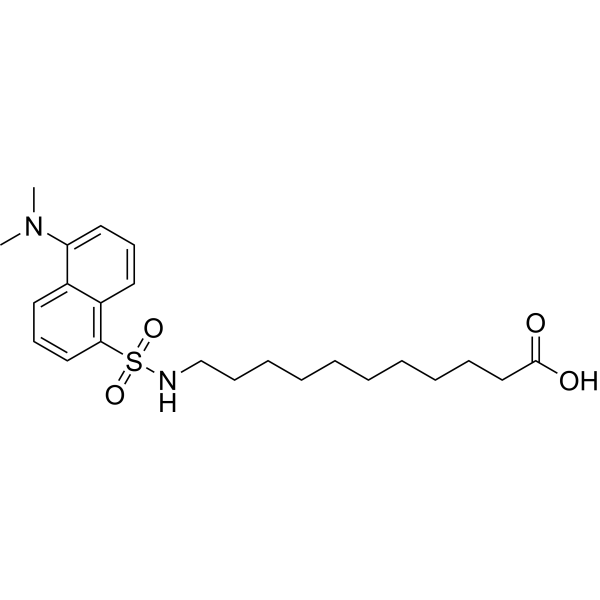
DAUDA is a fluorescent fatty acid analog probe, with Kd values of 0.63 μM, 0.82 μM, and 0.66 μM against subtypes/mutants of Schistosoma mansoni Sm14 fatty acid-binding protein, respectively. DAUDA binds to Sm14 fatty acid-binding protein variants, enters their non-polar binding pockets and alters fluorescence emission properties. DAUDA serves as a tracer in competitive binding assays with natural fatty acids to evaluate the fatty acid-binding capacity of Sm14 protein variants. DAUDA is applicable to the research of schistosomiasis .
loading...
    loading...
Cat. No.: HY-19261
CAS No.: 169042-78-8
Research Areas:  

Metabolic Disease

T-0632 is a CCK A receptor antagonist that exhibits significant pharmacological properties in in vitro studies. T-0632 competitively inhibits the binding of [125I]CCK-8 to rat pancreatic CCK A receptors with a K_i value of 0.24 nM, which is significantly lower than the K_i value for guinea pig CCK B receptors. T-0632 has higher selectivity in inhibiting CCK-8-stimulated pancreatic enzyme release, with an IC_50 value of 5.0 nM, which is more advantageous than L-364,718 and loxiglumide. In rabbit gallbladder smooth muscle, the antagonistic effects of T-0632 and loxiglumide are reversible, while L-364,718 shows a persistent inhibitory effect. These results indicate that T-0632 is a highly potent, reversible and more selective CCK A receptor antagonist.
loading...
    loading...
Cat. No.: HY-106884
CAS No.: 519-55-1
Cyrtominetin is a RANKL inhibitor with favorable ADMET properties. Cyrtominetin competitively blocks the binding of RANKL-RANK and increases the compactness of RANKL . Cyrtominetin can be used in studies related to osteoporosis .
loading...
    loading...
Cat. No.: HY-182921
CAS No.: 3142749-82-1
Target:  

GPR84 Enterovirus

Research Areas:  

Inflammation/Immunology

GPR84 antagonist 11 is a highly selective GPR84 antagonist, with a human pA2 of 8.41 and a pKi of 8.16. GPR84 antagonist 11 competitively inhibits the binding of agonists to the orthosteric site of GPR84 and has improved druglike properties, though its metabolic stability still requires optimization. GPR84 antagonist 11 can be used in the research of autoimmune diseases and fibrotic diseases .
loading...
    loading...
Cat. No.: HY-187642
CAS No.: 303059-39-4
Research Areas:  

Cancer

IGGi-11 is a competitive Gαi inhibitor with a Kd of 5.3 μM for sGαi3. IGGi-11 binds to the GIV interaction region of Gαi3, blocks non-canonical G protein signaling, and does not interfere with Gαi nucleotide processing, Gβγ binding, GPCR activation, or effector regulation. IGGi-11 inhibits the pro-invasive properties of metastatic breast cancer. IGGi-11 can be used in related studies on metastatic breast cancer .
loading...
    loading...
Cat. No.: HY-182354
CAS No.: 861877-12-5
Research Areas:  

Cancer

VEGFR2-IN-84 is an orally active, multi-targeted tyrosine kinase inhibitor based on a naphthalene ring scaffold. VEGFR2-IN-84 inhibits VEGFR2 with sub-nanomolar affinity and broadly targets kinases including Kit, FGFR, PDGFR, and Ret. By competitively binding to the ATP-binding pocket, VEGFR2-IN-84 blocks the phosphorylation of VEGFR2 and its downstream AKT/ERK signaling pathway, thereby significantly inhibiting endothelial cell proliferation, migration, and tumor angiogenesis. VEGFR2-IN-84 exhibits broad-spectrum antiproliferative activity against various solid tumors such as liver cancer, lung cancer, and renal cancer, shows weak toxicity to normal cells, and has superior potency to Lenvatinib (HY-10981). VEGFR2-IN-84 possesses favorable pharmacokinetic properties and high safety (LD50>2000 mg/kg), and can be used in related studies of various malignant tumors .
loading...
    loading...

