
27 Results for "

real-time image

" in MedChemExpress (MCE) Product Catalog:
Products (27)

27 Results for "real-time image" in MCE Product Catalog:

1
1 Cited Publications
Cat. No.: HY-D1244
CAS No.: 1043865-37-7
CO probe 1 (probe 2) is a highly efficient fluorescent CO probe (Ex=493 nm) with an allyl ether reaction site. In the presence of PdCl₂, CO reduces Pd 2+ to Pd 0, triggering a Tsuji-Trost reaction that removes the allyl protecting group, releases fluorescein, and generates a significant fluorescence signal. CO probe 1 has high selectivity, rapid response (fluorescence enhancement of 150 times within 20 minutes), and low cytotoxicity, and can be used for real-time imaging of CO in living cells. CO probe 1 may be used to study pathological mechanisms involving CO signaling regulation, such as inflammation, vascular disease, or cancer .
loading...
    loading...
Cat. No.: HY-D0920
CAS No.: 166196-17-4
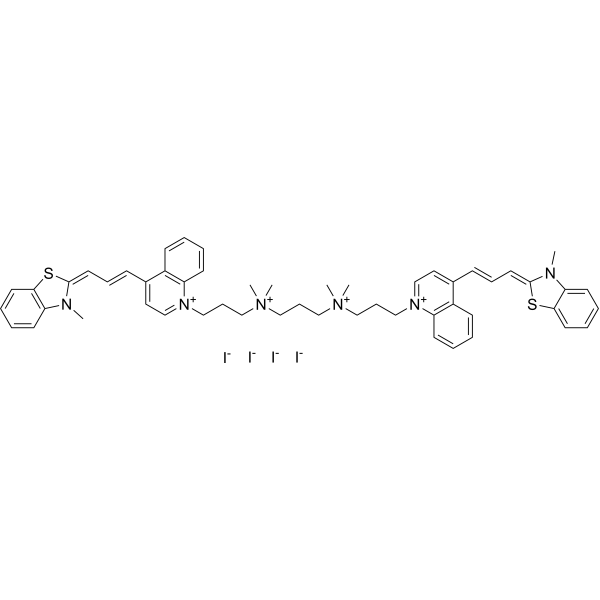
TOTO-3 is a cyanine nucleic acid intercalating fluorescent probe that binds to both RNA and DNA (Ex=642 nm, Em=660 nm). TOTO-3 cannot enter intact cells, but can penetrate cells with permeabilized plasma membranes, staining cytoplasmic RNA and nucleoli to distinguish intact cells from damaged ones. TOTO-3 is taken up by macrophages in an ultrasound-independent manner. TOTO-3 accumulates in tumor cells via ultrasound-mediated enhancement of plasma membrane permeability. TOTO-3 supports optical imaging for real-time assessment of plasma membrane integrity, nucleic acid detection, and monitoring of ultrasound-mediated intracellular delivery processes. TOTO-3 is applicable to studies related to rectal cancer .
loading...
    loading...
Cat. No.: HY-D2931
CAS No.: 1154528-97-8
SNAP-FAM is a FAM-labeled SNAP tag fluorescent probe, specifically designed for live-cell protein labeling and real-time imaging applications .
loading...
    loading...
Cat. No.: HY-163618
Research Areas:  

Cancer

DHMQ is a NIR fluorescent probe that binds to the propylamino group of monoamine oxidase A (MAO-A). DHMQ tracks MAO-A activity in real-time by using fluorescence imaging on mice and cells .
loading...
    loading...
Cat. No.: HY-D2971
CAS No.: 2781892-92-8
NCIC-VIS is a lysosome-targeted, viscosity-sensitive two-photon near-infrared fluorescent probe. NCIC-VIS has a rigid structure that can restrict molecular torsion, thereby increasing the fluorescence quantum yield and two-photon absorption cross-section. NCIC-VIS enables real-time imaging of the autophagy process in cells .
loading...
    loading...
Cat. No.: HY-W112090
CAS No.: 72076-09-6
Synonyms: PdTFPP; 5,10,15,20-Tetrakis(pentafluorophenyl)-21H,23H-porphine palladium(II)
Target:  

Fluorescent Dye

Research Areas:  

Others

Palladium meso-tetra(pentafluorophenyl)porphyrin (PdTFPP) derives from palladium(II), acting as a fluorescence-quenched optical probe and high-performance oxygen concentration sensor with outstanding photostability and antioxidant capacity. Palladium meso-tetra(pentafluorophenyl)porphyrin exhibits reduced luminescence intensity as dissolved oxygen concentration rises. Palladium meso-tetra(pentafluorophenyl)porphyrin can be applied for real-time monitoring of live-cell respiration, hypoxic tissue imaging, and nanofibrous organic semiconductors in photodetectors for ambient oxygen detection .
loading...
    loading...
Cat. No.: HY-D1637
CAS No.: 172646-43-4
Target:  

Fluorescent Dye

Research Areas:  

Others

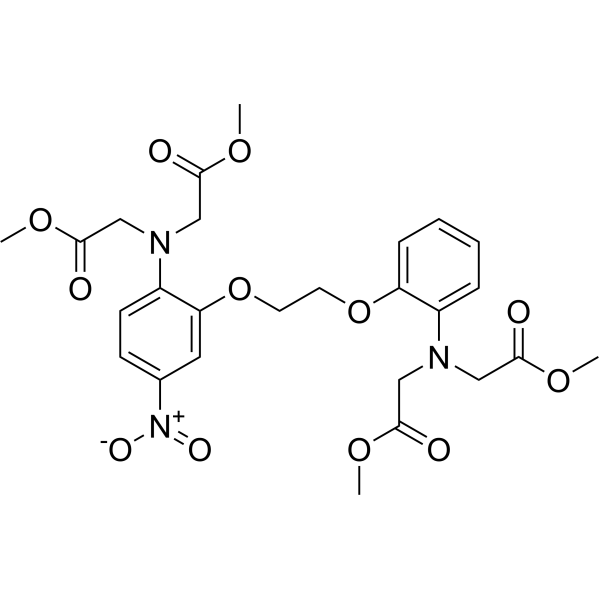
5-Nitro BAPTA tetramethyl ester is a calcium chelator. 5-Nitro BAPTA tetramethyl ester involves in the two-photon probe synthesis, and is used for real-time imaging of intracellular calcium ions, calcium waves monitoring at a depth of 100-300 μm in liver tissues for 1100-4000 s. 5-Nitro BAPTA tetramethyl ester, together with fluorescent compound 2-Me-substituted TM, can be used to form a red fluorescent probe (CaTM-2 AM) .
loading...
    loading...
Cat. No.: HY-145769
CAS No.: 2547100-02-5
Target:  

PD-1/PD-L1

Research Areas:  

Cancer

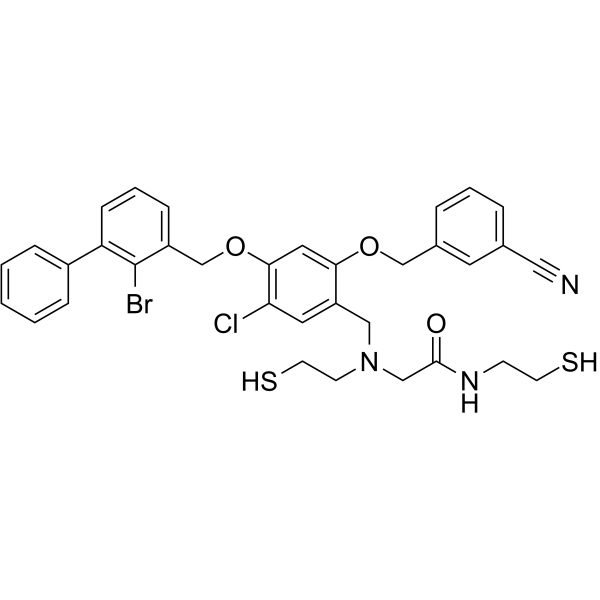
N2S2-CBMBC, an N2S2 bromo-benzyl ether derivative, acts as a ligand and use 99mTc-labelled complexes 99mTc-N2S2-CBMBC can be used as an imaging agent to be applied to the aspect of detecting PD-L1 expression, realize the real-time, comprehensive and convenient detection of the PD-L1 level of tumors, and overcome the defects of an immunohistochemical method .
loading...
    loading...
Cat. No.: HY-D3005
NpCy-4 is a reliable reporter for monitoring lysosomal pH and viscosity changes in real time during Autophagy (λex = 650 nm; λem = 660-740 nm). NpCy-4 demonstrates a superior signal-to-background ratio (SBR) for cellular imaging. NpCy-4 facilitates real-time, noninvasive diagnostic imaging of acute gastritis model with high contrast .
loading...
    loading...
Cat. No.: HY-D1997
CAS No.: 1210944-09-4
Target:  

Fluorescent Dye

Research Areas:  

Others

ATTO 665 is a near-infrared amine-reactive fluorescent NHS ester dye that can covalently label chitosan for in vivo tracking, or label phage coat proteins for validation of fungal cell binding, and can be used for background monitoring in real-time PCR. ATTO 665 can be used for biomolecular fluorescent labeling and in vivo imaging studies .
loading...
    loading...
Cat. No.: HY-161981
Target:  

Apoptosis

Research Areas:  

Cancer

Antitumor agent-187 (compound I3) is a photosensitizer based on 5,15-diaryltetrabenzoporphyrin with a maximum absorption wavelength of ~668 nm and anticancer activity. Antitumor agent-187 can induce apoptosis and can be used in photodynamic therapy (PDP). Antitumor agent-187 selectively accumulates at tumor sites and has real-time fluorescence imaging capabilities .
loading...
    loading...
Cat. No.: HY-D2266
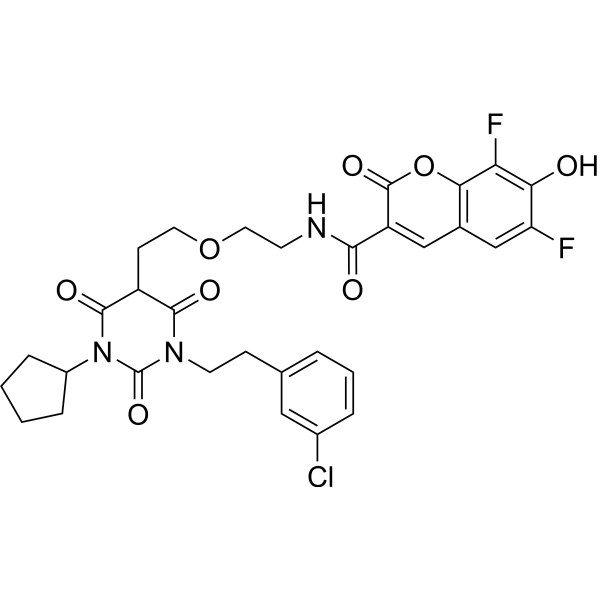
FluoBar1 is an imaging fluorescence probe modified by a barbiturate ligand with fluorescent coumarin. FluoBar1 can monitor L-type voltage-gated calcium channels (LTCC) in living cells in real time for the study of neurological diseases .
loading...
    loading...
Cat. No.: HY-D3224
CAS No.: 2413777-91-8
HCP is a two-photon fluorescent probe capable of crossing the blood-brain barrier, which is specifically designed for real-time detection of hypochlorous acid (HClO/ClO -) produced by myeloperoxidase (MPO). Chlorination of the quinoline skeleton of HCP generates HCP-Cl, which eliminates intramolecular charge transfer (ICT) quenching and thereby produces fluorescence. HCP is suitable for in vivo dynamic imaging of HClO in the brains of epileptic mice and high-throughput screening of antiepileptic drugs (HCP-Cl: Ex/Em = 800 nm/495 nm) .
loading...
    loading...
Cat. No.: HY-D3364
Research Areas:  

Others

RL480 is a green-emitting RNA fluorescent dye used for selective RNA labeling and imaging. RL480 contains an acylimidazole reactive group that undergoes selective acylation with the 2′-OH group of RNA ribose, and restricts intramolecular rotation through covalent binding to relieve the TICT quenching effect, thereby generating a fluorescence enhancement signal. RL480 enables selective fluorescent labeling of RNA over DNA, and is applicable to RNA gel detection, real-time RNA synthesis monitoring and live-cell RNA imaging. The detection wavelengths are Ex/Em = 480 nm/514 nm .
loading...
    loading...
Cat. No.: HY-D3366
Target:  

Fluorescent Dye

Research Areas:  

Others

Th-TMR-S-Halo is a fluorescent probe for HaloTag labeling and live-cell imaging, including super-resolution imaging and real-time visualization of endoplasmic reticulum (ER) vortex formation under ER stress conditions. Th-TMR-S-Halo shows weak fluorescence in the free state, and upon covalent binding to HaloTag, fluorescence activation is achieved by restricting the rotation of the thiophene ring. Th-TMR-S-Halo can be used in studies related to intracellular protein localization, cytoskeleton structure, and ER vortex formation. Live-cell NSPARC super-resolution detection is performed using Ex/Em = 561/570-616 nm .
loading...
    loading...
Cat. No.: HY-D3110
CAS No.: 2757682-03-2
NRGolgi is a Nile Red-based solvatochromic fluorescent probe targeted to the Golgi apparatus. NRGolgi localizes selectively to the Golgi membrane via its myristic acid group, and leverages the property of its emission wavelength undergoing blue/red shift with local polarity to quantitatively detect the lipid order of the Golgi membrane in living cells using dual-emission ratiometric imaging (550-600 nm / 600-650 nm). NRGolgi is suitable for real-time monitoring of Golgi lipid order under conditions of oxidative stress, mechanical stress, and altered cholesterol metabolism .
loading...
    loading...
Cat. No.: HY-D3398
FlavAc is a fluorescent dye (with an excitation wavelength of 980 nm) for real-time in vivo imaging of lipid metabolism disorders, including early fatty liver disease and atherosclerotic plaques. FlavAc specifically integrates into endogenous lipoproteins, primarily low-density lipoprotein (LDL), and shows no brightness enhancement when bound to albumin. FlavAc forms aggregates in aqueous solutions, leading to fluorescence quenching; however, when integrated into lipoproteins, such aggregation decreases, forming stable fluorescent complexes with enhanced brightness. FlavAc can selectively illuminate LDL upon laser irradiation .
loading...
    loading...
Cat. No.: HY-D3195
CAS No.: 2028316-19-8
CDr15 is a deep-red fluorescent probe (Ex=733 nm) that can selectively intercalate into and label bacterial extracellular DNA (eDNA). CDr15 exhibits extremely high specificity for biofilm imaging and cannot effectively bind to mammalian nuclear DNA. CDr15 enables real-time visualization of the microcolony structure and developmental process of three-dimensional *Pseudomonas aeruginosa* biofilms, and accurately localizes biofilm-forming regions of microorganisms in a mouse corneal infection model. With low background interference signals, CDr15 serves as an ideal diagnostic tool for research fields including bacterial biofilms and corneal infections .
loading...
    loading...
Cat. No.: HY-D2991
CAS No.: 2081872-38-8
CDG-DNB3 is a selective fluorescent probe for Mycobacterium tuberculosis. CDG-DNB3 provides rapid and specific labeling of live Mycobacterium tuberculosis. CDG-DNB3 can image Bacillus Calmette-Guérin phagocytosis in real time .
loading...
    loading...
Cat. No.: HY-D3146
CAS No.: 1418017-91-0
Target:  

Fluorescent Dye

Research Areas:  

Others

Di-4-AN (F) EPPTEA is a voltage-sensitive dye used for membrane potential imaging and optical recording of electrical activity in excitable cells and tissues. Its detection mechanism is based on electrochromism (also known as the molecular Stark effect). The single-photon excitation/emission wavelengths measured in ethanol solution are Ex/Em = 444/610 nm, and it can be excited via 1064 nm two-photon excitation in optical recording applications. Di-4-AN (F) EPPTEA can be used to record backpropagating action potentials in individual dendritic spines of brain cortical slices, map subcellular action potential characteristics of single cardiomyocytes, and perform real-time recording of multicellular action potentials in cerebellar slices .
loading...
    loading...

