13 Results for "

redox state

" in MedChemExpress (MCE) Product Catalog:
Products (13)

13 Results for "redox state" in MCE Product Catalog:

11
11 Publications Verification
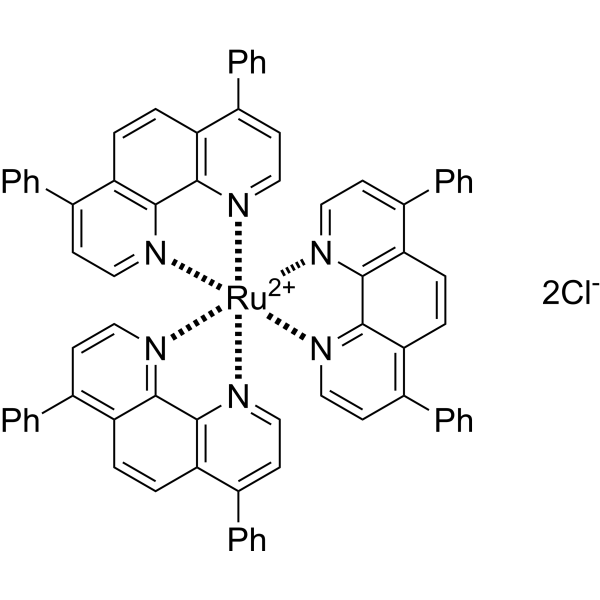
Cat. No.: HY-W074143
CAS No.: 36309-88-3
Synonyms: [Ru(DPP)3]Cl2
Tris(4,7-diphenyl-1,10-phenanthroline)ruthenium(II) dichloride ([Ru(dpp)3] 2+) is an electrochemiluminescent (ECL) probe and oxygen-sensitive sensor. Tris(4,7-diphenyl-1,10-phenanthroline)ruthenium(II) dichloride can be used to modify electrode surfaces for the detection of sulfates (S2O8 2-) and oxalates, based on electrochemical reactions that generate excited-state species, releasing photons through irreversible redox reactions. Tris(4,7-diphenyl-1,10-phenanthroline)ruthenium(II) dichloride utilizes the oxygen quenching of fluorescence mechanism, where fluorescence intensity reflects the metabolic rate of living microorganisms or oxygen levels within cells/tumors, allowing for real-time detection. Tris(4,7-diphenyl-1,10-phenanthroline)ruthenium(II) dichloride's main applications include microbial detection, antibacterial activity studies, and tumor microenvironment research .
loading...
    loading...
6
6 Cited Publications
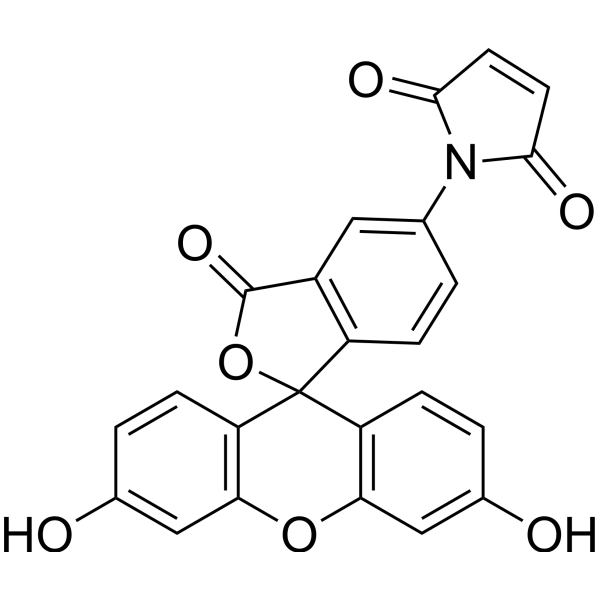
Cat. No.: HY-D0098
CAS No.: 75350-46-8
Synonyms: N-(5-Fluoresceinyl)maleimide
Fluorescein-5-maleimide (N-(5-Fluoresceinyl)maleimide) is a fluorescent dye. Fluorescein-5-maleimide can be used to detect the redox state of thiols in eukaryotic cells. Fluorescein-5-maleimide can label peptides and is used to detect negatively charged nanoparticles. Fluorescein-5-maleimide can also label actin to explore its interaction with cardiac myosin-binding protein C (cMyBP-C), which helps in developing small molecule modulators for heart failure. Fluorescein-5-maleimide can screen mutant proteins that contain cysteine residues. The excitation wavelength of Fluorescein-5-maleimide is 494 nm, and the emission wavelength is 519 nm .
loading...
    loading...
1
1 Cited Publications
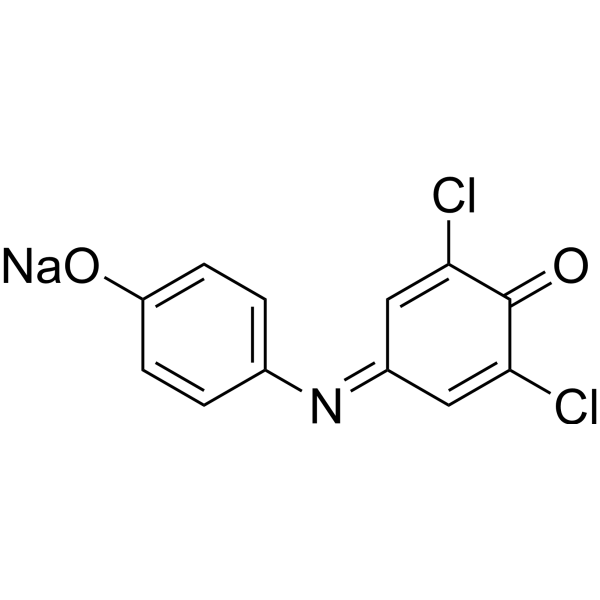
Cat. No.: HY-D0018
CAS No.: 620-45-1
Synonyms: Dichlorophenylindophenol sodium; DCPIP sodium; Indochlorophenol sodium
DCIP sodium is a blue dye commonly used in various biochemical and biotechnological applications as an indicator of redox reactions. DCIP sodium has unique chemical properties that change color according to the oxidation state of the substance being tested. It is commonly used in enzyme assays, such as measuring the activity of succinate dehydrogenase, or in protein quantification methods, such as the Lowry assay.
loading...
    loading...
Cat. No.: HY-135849A
CAS No.: 9001-05-2
Research Areas:  

Others Cancer

Catalase, Bovine Liver is an enzyme widely found in various organisms, including animals, plants and microorganisms. Catalase, Bovine Liver mainly exists in the peroxisome of cells and is an important antioxidant enzyme. Catalase, Bovine Liver plays an important role in removing ROS and maintaining the balance of redox state. Catalase, Bovine Liver is closely related to the occurrence and development of tumors. Catalase, Bovine Liver has the potential to be used in tumor prevention research .
loading...
    loading...
Cat. No.: HY-125953
CAS No.: 477243-06-4
Synonyms: Ceramide (Egg, Chicken)
Ceramide (Egg) (Ceramide (Egg, Chicken)) is a ceramide from chicken. Ceramide (Egg) is a sphingomyelin signaling pathway second messenger. Ceramide (Egg) activates PP2A, JNK, p38 MAPK, CAPK, ceramide-activated protein phosphatase, Vav, PKCζ, and SAPK/JNK cascade. Ceramide (Egg) downregulates or inhibits AKT, survivin, CDK2, mTOR, and FLIP. Ceramide (Egg) mediates apoptosis, autophagy, cell cycle arrest, mitochondrial dysfunction, redox state shifts, and ROS generation. Ceramide (Egg) can be used for the research of cancer and neurological disease .
loading...
    loading...
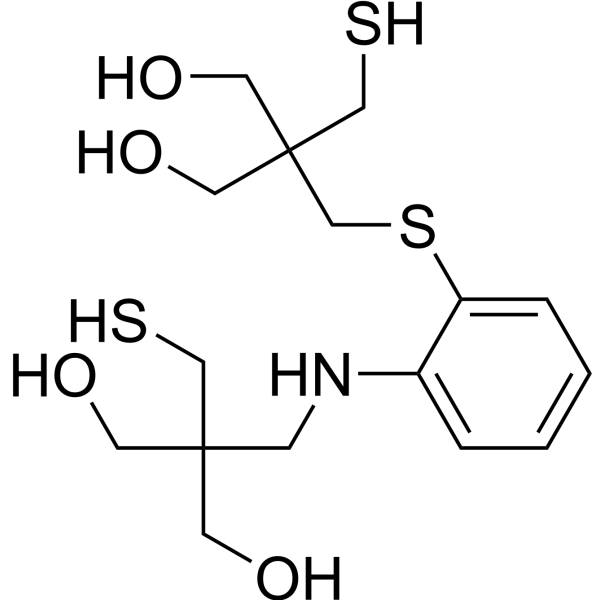
Cat. No.: HY-163200
CAS No.: 3034768-68-5
Target:  

Cuproptosis

Research Areas:  

Neurological Disease

Cu(I) chelator 1 (Compound LH2) is a chelator which targets the Cu(I) redox state. Cu(I) chelator 1 prevents ROS production .
loading...
    loading...
Cat. No.: HY-N11882
CAS No.: 4299-57-4
Synonyms: PQ-9
Plastoquinone (PQ-9) is a photosynthetic electron carrier as well as a redox sensor capable of regulating state transitions and gene expression. Plastoquinone transfers electrons to the cytochrome b6/f complex via the Q cycle, and participates in the establishment of the thylakoid transmembrane pH gradient. Plastoquinone can react with ROS. Plastoquinone is used in plant photosynthesis research .
loading...
    loading...
Cat. No.: HY-17659
CAS No.: 112055-76-2
Target:  

Drug Derivative

Research Areas:  

Others

Decylplastoquinone is lipid-soluble derivative of plastoquinone (HY-N11882). Plastoquinone (PQ-9), a potent electron carrier, is an essential component of photosynthesis. Plastoquinone is also a redox sensor that regulates state transitions and gene expression .
loading...
    loading...
Cat. No.: HY-D0018R
CAS No.: 620-45-1
Synonyms: Dichlorophenylindophenol sodium (Standard); DCPIP sodium (Standard); Indochlorophenol sodium (Standard)
DCIP (sodium) (Standard) is the analytical standard of DCIP (sodium). This product is intended for research and analytical applications. DCIP sodium is a blue dye commonly used in various biochemical and biotechnological applications as an indicator of redox reactions. DCIP sodium has unique chemical properties that change color according to the oxidation state of the substance being tested. It is commonly used in enzyme assays, such as measuring the activity of succinate dehydrogenase, or in protein quantification methods, such as the Lowry assay.
loading...
    loading...
Cat. No.: HY-W550315
CAS No.: 32381-28-5
Synonyms: DACDM
Dimethyl diacetyl cystinate (DACDM) is a potent NF-κB inhibitor. Dimethyl diacetyl cystinate shifts the intracellular redox balance toward the oxidized state by increasing intracellular oxidized glutathione (GSSG) content, competitively blocking the binding of activated NF-κB to DNA, thereby inhibiting the production of inflammatory factors such as IL-1κ. Dimethyl diacetyl cystinate is promising for research of UVB-induced skin inflammation and related oxidative stress diseases .
loading...
    loading...
Cat. No.: HY-W141446
CAS No.: 144163-68-8
Research Areas:  

Others

VT00065 is a covalent DHS inhibitor. VT00065 forms a redox-dependent covalent bond with the catalytic lysine K329 of DHS, locking the enzyme in an inactive state .
loading...
    loading...
Cat. No.: HY-W162231
CAS No.: 91216-38-5
Target:  

Bacterial

Research Areas:  

Infection Metabolic Disease

HC102A is an Antibacterial agent and an inhibitor of DosS and DosT histidine sensor kinases, with an IC50 of 1.9 μM against Mycobacterium tuberculosis DosS. HC102A does not alter the heme redox state of sensor kinases. HC102A reduces triacylglycerol synthesis and accumulation, decreases the survival rate of Mtb under non-replicating persistent and hypoxic conditions, and enhances the sensitivity of Mtb to Isoniazid (HY-B0329). HC102A can be used in research related to tuberculosis .
loading...
    loading...
Cat. No.: HY-DY1088
CAS No.: 75350-46-8
Synonyms: N-(5-Fluoresceinyl)maleimide (solution)
Fluorescein-5-maleimide (solution) (N-(5-Fluoresceinyl)maleimide (solution)) is a fluorescent dye. Fluorescein-5-maleimide can be used to detect the redox state of thiols in eukaryotic cells. Fluorescein-5-maleimide can label peptides and is used to detect negatively charged nanoparticles. Fluorescein-5-maleimide can also label actin to explore its interaction with cardiac myosin-binding protein C (cMyBP-C), which helps in developing small molecule modulators for heart failure. Fluorescein-5-maleimide can screen mutant proteins that contain cysteine residues. The excitation wavelength of Fluorescein-5-maleimide is 494 nm, and the emission wavelength is 519 nm .

Solvent and concentration: DMSO: 10 mM
loading...
    loading...
  • 1

