7 Results for "

thermal decomposition

" in MedChemExpress (MCE) Product Catalog:
Products (7)

7 Results for "thermal decomposition" in MCE Product Catalog:

Cat. No.: HY-W087905
CAS No.: 1889-67-4
Research Areas:  

Others

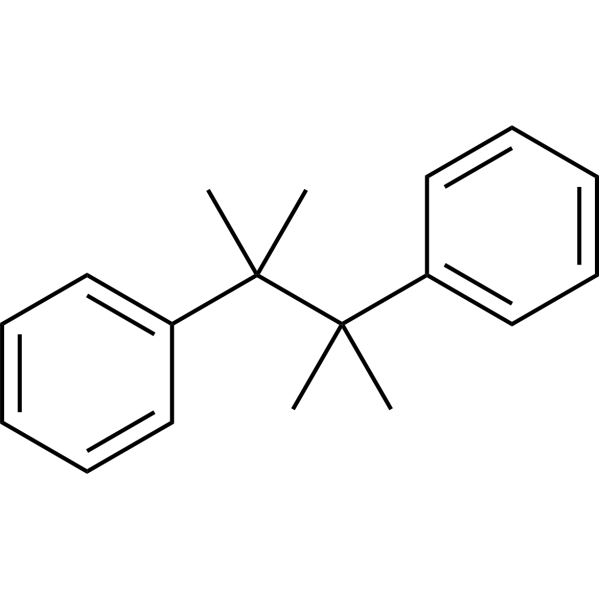
2,3-Dimethyl-2,3-diphenylbutane is a minor product formed during the thermal decomposition of dicumyl peroxide (DCP) in cumene, generated through radical coupling reactions. As an initiator capable of producing free radicals, 2,3-dimethyl-2,3-diphenylbutane promotes cross-linking or decomposition processes via initiating free radical reactions in fields such as polymer polymerization (e.g., modification of polyphenylene oxide processing), organic synthesis (e.g., DCP decomposition reactions), and coal processing (e.g., oxidation stabilization of coal tar pitch), thereby enhancing material properties or reaction efficiency .
loading...
    loading...
Cat. No.: HY-W391506
CAS No.: 9011-14-7
Synonyms: Poly(methyl methacrylate), beads; PMMA
Research Areas:  

Others

Poly (methyl methacrylate) (Poly(methyl methacrylate), beads; PMMA) is an amorphous glassy acrylic thermoplastic polymer belonging to the acrylate family, synthesized from methyl methacrylate monomers. Poly (methyl methacrylate) drives biochemical processes including free volume expansion induced by inelastic deformation, yield stress and strain softening regulated by physical aging, acid hydrolysis to polymethacrylic acid, multi-stage combustion, oxygen-dependent thermal decomposition, primary amine-mediated polypentanimide formation, and grafting/crosslinking-based copolymer and composite formation. Poly (methyl methacrylate) exhibits histocompatibility, low toxicity, low inflammatory potential, and fracture resistance; it can form functional blends and composites for biomedical and dental applications; it also allows performance-enhancing chemical and mechanical modifications. Poly (methyl methacrylate) is applicable to studies related to cranial repair .
loading...
    loading...
Cat. No.: HY-167629
CAS No.: 546-09-8
Research Areas:  

Others

Gibberellenic acid is an intermediate gibberellin compound with a tetracyclic diterpenoid skeleton, and can be generated by thermal decomposition of Gibberellic acid (GA3, HY-N1964) in aqueous solution. Gibberellenic acid is thermally unstable in water and can further convert into allogibberic acid (approximately 80%) and 9-epiallogibberic acid (approximately 10%). It plays an important role in the degradation pathway and structural elucidation of Gibberellins .
loading...
    loading...
Cat. No.: HY-112013
CAS No.: 3344-11-4
Target:  

Cholinesterase (ChE)

Research Areas:  

Neurological Disease

Isodimethoate is a thermal decomposition product of Dimethoate (HY-B1946). Isodimethoate is a direct anticholinesterase agent and shows an inhibition to human red blood cell acetylcholinesterase (AChE) .
loading...
    loading...
Cat. No.: HY-133077
CAS No.: 34812-73-2
Synonyms: DEC N-oxide
Target:  

Drug Metabolite

Research Areas:  

Others

Diethylcarbamazine N-oxide (DEC N-oxide) is the N-oxide metabolite of Diethylcarbamazine (HY-12642A). Diethylcarbamazine N-oxide is stable to extraction in alkalinized urine but with low efficiency, and can be converted to Diethylcarbamazine upon thermal decomposition or reduction by sulfur dioxide. Diethylcarbamazine N-oxide can be used for the study of Diethylcarbamazine metabolism .
loading...
    loading...
Cat. No.: HY-184634
OA Coated Fe3O4 Nanoparticles (Oleic acid-modified iron(III) oxide nanoparticles) were prepared using a high-temperature pyrolysis method. Oleic acid was added as a surfactant to a solution containing an iron precursor. Oleic acid not only helps control the growth of nanoparticles but also forms a stable coating on the particle surface. The solution containing the iron precursor and oleic acid was heated to a high temperature, typically around 300°C, to promote the thermal decomposition of the iron precursor. At high temperatures, the iron precursor decomposes to produce iron atoms, which aggregate to form magnetic nanoparticles. During pyrolysis, the iron nanoparticles react with oxygen in the air to form iron(III) oxide (Fe3O4).
loading...
    loading...
Cat. No.: HY-79587
CAS No.: 134-81-6
Research Areas:  

Others

Benzil is a 1,2-diketone compound with multiple functions including photo-peroxidation initiator, crosslinking initiator and pattern-forming agent, and is commonly used as a precursor for photodegradable network crosslinkers. In oxygen-purged polymer films or glassy matrices, Benzil reacts with molecular oxygen under illumination at wavelengths greater than 370 nm or 400 nm, and converts to benzoyl peroxide in nearly quantitative yield. Subsequently, the generated benzoyl peroxide groups produce free radicals via thermal or photochemical decomposition, thereby enabling crosslinking of polymer chains, grafting of new monomers, and preparation of patterned polymers on solid surfaces using mask irradiation. Benzil also induces crosslinking of photodegradable poly (phenyl vinyl ketone) to form a stable photodegradable polymer network .
loading...
    loading...

