27 Results for "

inactivated state

" in MedChemExpress (MCE) Product Catalog:
Products (27)

27 Results for "inactivated state" in MCE Product Catalog:
14
14 Publications Verification
Cat. No.: HY-10015
CAS No.: 870653-45-5
Purity:  99.83%
Synonyms: 5-(4-Phenoxybutoxy)psoralen
Target:  

Potassium Channel

Research Areas:  

Inflammation/Immunology

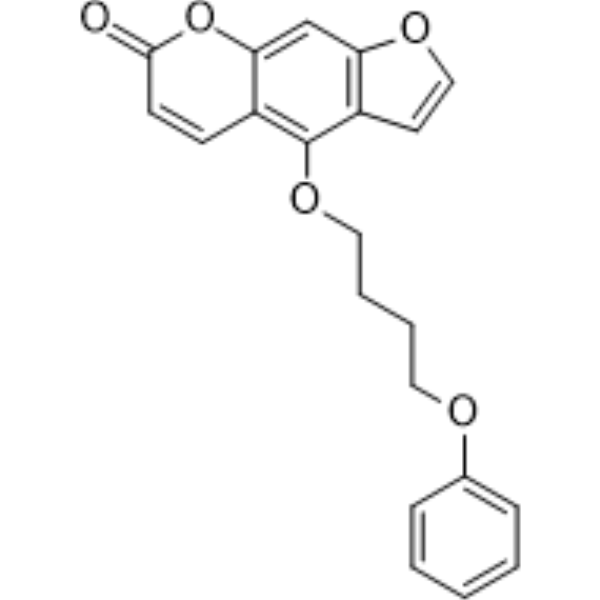
PAP-1 (5-(4-Phenoxybutoxy)psoralen) is a potent, selective, and orally active Kv1.3 blocker (EC50=2 nM). PAP-1 blocks Kv1.3 in a use-dependent manner and acts by preferentially binding to the C-type inactivated state of the channel. PAP-1 exhibits 23-fold selectivity over Kv1.5 (EC50=45 nM), and further displays 33- to 125-fold selectivity over all other Kv1-family channels. PAP-1 does not exhibit cytotoxic or phototoxic effects .
loading...
    loading...
Cat. No.: HY-120751
CAS No.: 1309601-26-0
Target:  

Calcium Channel

Research Areas:  

Neurological Disease

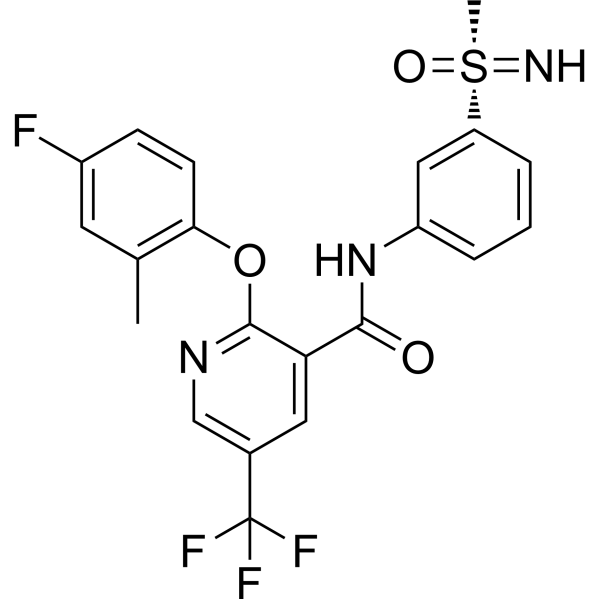
TROX-1 is a selective, orally active and brain-penetrant N-type calcium channel (Cav2.2) inhibitor with an IC50 value of 0.11 μM. TROX-1 exerts state-dependent and use-dependent inhibition, preferentially targets open/inactivated channels, blocks depolarization-associated calcium influx, and fully blocks calcium influx in rat dorsal root ganglion neurons. TROX-1 reverses inflammatory-induced hyperalgesia, nerve injury-induced allodynia. TROX-1 can be used for the research of pain .
loading...
    loading...
Cat. No.: HY-B0516
CAS No.: 23964-57-0
Synonyms: Hoe-045
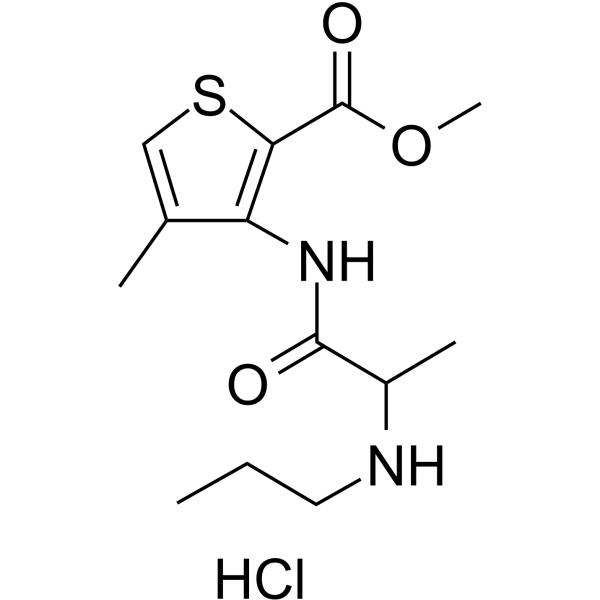
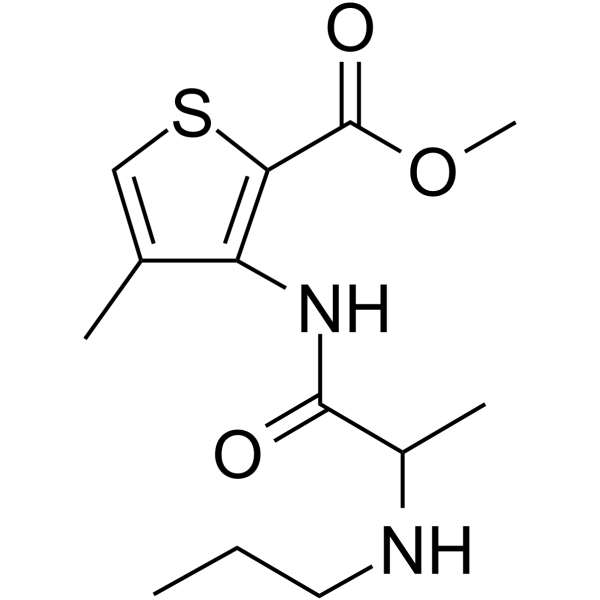
Articaine (Hoe-045) hydrochloride is a selective inhibitor of voltage-gated sodium channels (such as rNav1.4, hNav1.7, and rNav1.8), with an IC50 of 15.8 μM for open-state Na + channels, and IC50 of 40.6 μM and 378 μM for inactivated and resting-state Na + channels, respectively. Articaine hydrochloride exerts local anesthetic activity by inhibiting Na + influx to block nerve impulse conduction, and can also inhibit NF-κB activation and NLRP3 inflammasome pathways, exhibiting anti-inflammatory function. Articaine hydrochloride can be used in the study of dental local anesthesia and inflammatory-related diseases (such as acute kidney injury) .
loading...
    loading...
Cat. No.: HY-157802
CAS No.: 2834106-06-6
Purity:  99.35%
Target:  

Sodium Channel

Research Areas:  

Neurological Disease

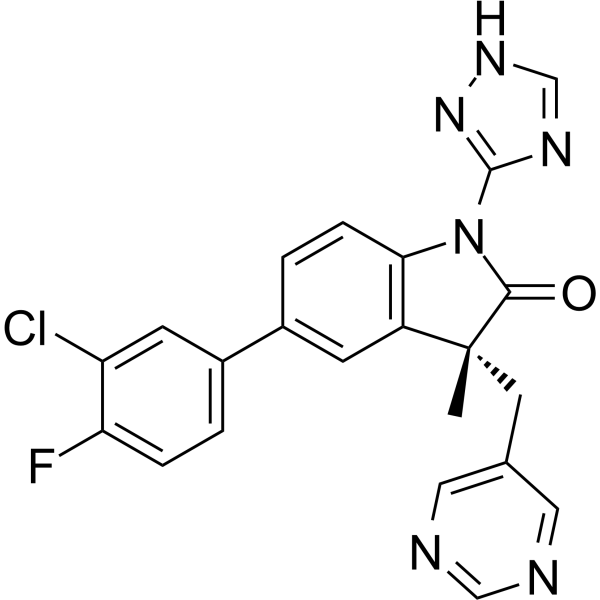
LTGO-33 is a potent and selective voltage-gated sodium channel NaV1.8 inhibitor. LTGO-33 inhibits NaV1.8 in the nM potency range and exhibits over 600-fold selectivity against human NaV1.1-NaV1.7 and NaV1.9. LTGO-33 exhibits state-independent inhibition with similar potencies on channels in the closed and inactivated conformations. LTGO-33 inhibits native TTX-R NaV1.8 currents in non-human primate and human DRG neurons, where it reduces action potential firing. LTGO-33 can be used for pain disorders research .
loading...
    loading...
Cat. No.: HY-136330
CAS No.: 1616678-32-0
Purity:  99.88%
Research Areas:  

Infection

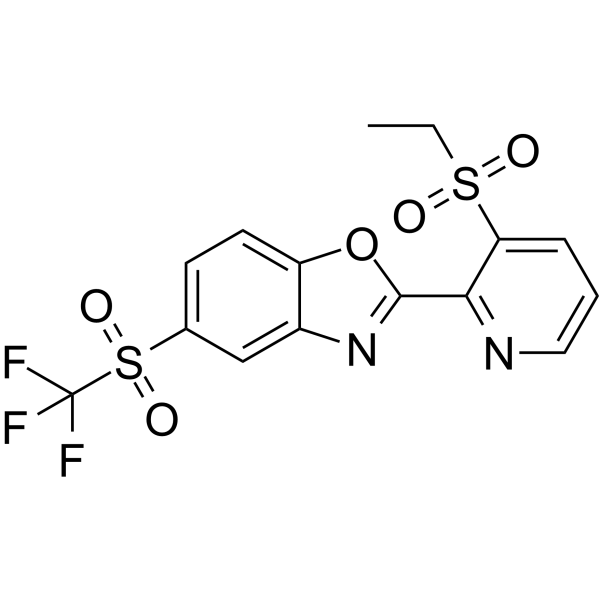
Oxazosulfyl is a sulfyl insecticide with potent and cross-spectrum insecticidal activity. Oxazosulfyl inhibits sodium currents by binding to and stabilizing the slow-inactivated state of voltage-gated sodium channels, leading to insect paralysis. Oxazosulfyl's ability to block sodium channels is correlated with its insecticidal activity .
loading...
    loading...
Cat. No.: HY-178963
CAS No.: 7469-49-0
Research Areas:  

Neurological Disease

Nav1.2-IN-2 is a Nav1.2 inhibitor with a human IC50 of 0.18 μM. Nav1.2-IN-2 preferentially binds to the inactivated state of Nav1.2, reduces window current, suppresses neuronal depolarization and action potential generation. Nav1.2-IN-2 suppresses Veratridine (HY-N6691)-induced Ca 2+ influx. Nav1.2-IN-2 can be used for the research of epilepsy .
loading...
    loading...
Cat. No.: HY-178494
CAS No.: 3097995-73-5
Research Areas:  

Neurological Disease

Nav1.7-IN-19 is a potent, selective and orally active Nav1.7 inhibitor with an IC50 of 0.49 μM. Nav1.7-IN-19 shows high selectivity for Nav1.7, with selectivities of 312-fold and 662-fold against Nav1.1 and Nav1.5 in the inactivated state. Nav1.7-IN-19 exhibits weak inhibition on hERG potassium channels. Nav1.7-IN-19 exhibits analgesic effect and can be used for the research of neurological disease .
loading...
    loading...
Cat. No.: HY-123414
CAS No.: 1235406-09-3
Synonyms: PF-05196233
Target:  

Sodium Channel

Research Areas:  

Neurological Disease

GX-936 (PF-05196233) is a selective Nav1.7 inhibitor. GX-936 binds to the activated VSD4, forms a bidentate salt bridge with the R4 of the S4 helix, traps VSD4 in the activated state, and prevents the channel from recovering from the inactivated state. GX-936 can be used in studies related to pain .
loading...
    loading...
Cat. No.: HY-10015R
CAS No.: 870653-45-5
Synonyms: 5-(4-Phenoxybutoxy)psoralen (Standard)
PAP-1 (Standard) is the analytical standard of PAP-1. This product is intended for research and analytical applications. PAP-1 (5-(4-Phenoxybutoxy)psoralen) is a potent, selective, and orally active Kv1.3 blocker (EC50=2 nM). PAP-1 blocks Kv1.3 in a use-dependent manner and acts by preferentially binding to the C-type inactivated state of the channel. PAP-1 exhibits 23-fold selectivity over Kv1.5 (EC50=45 nM), and further displays 33- to 125-fold selectivity over all other Kv1-family channels. PAP-1 does not exhibit cytotoxic or phototoxic effects .
loading...
    loading...
Cat. No.: HY-171778
CAS No.: 2835455-57-5
QLS-81 is a Nav1.7 channel inhibitor (IC50: 1.5 μM). QLS-81 has significant analgesic activity and can relieve neuropathic and inflammatory pain. QLS-81 exerts frequency-dependent inhibitory effects by inhibiting the inactivated state of Nav1.7 channels. QLS-81 can be used in the study of chronic pain .
loading...
    loading...
Cat. No.: HY-B0516A
CAS No.: 23964-58-1
Synonyms: Hoe-045 free base
Articaine (Hoe-045) is a selective inhibitor of voltage-gated sodium channels (such as rNav1.4, hNav1.7, and rNav1.8), with an IC50 of 15.8 μM for open-state Na + channels, and IC50 of 40.6 μM and 378 μM for inactivated and resting-state Na + channels, respectively. Articaine exerts local anesthetic activity by inhibiting Na + influx to block nerve impulse conduction, and can also inhibit NF-κB activation and NLRP3 inflammasome pathways, exhibiting anti-inflammatory function. Articaine can be used in the study of dental local anesthesia and inflammatory-related diseases (such as acute kidney injury) .
loading...
    loading...
Cat. No.: HY-B0161C
CAS No.: 116539-60-7
Synonyms: (R)-LY248686
Target:  

Sodium Channel

Research Areas:  

Neurological Disease

(R)-Duloxetine ((R)-LY248686) is a neuronal voltage-gated sodium channel blocker with analgesic activity. (R)-Duloxetine blocks Na + currents with higher affinity for the inactivated state than for the resting state. (R)-Duloxetine alleviates postoperative mechanical allodynia and hyperalgesia. (R)-Duloxetine exerts its effects through a local peripheral mechanism of action. (R)-Duloxetine can be used for research on postoperative (post-incisional) pain .
loading...
    loading...
Cat. No.: HY-B0161D
CAS No.: 910138-96-4
Synonyms: LY248686 hydrochloride
Target:  

Sodium Channel

Research Areas:  

Neurological Disease

(R)-Duloxetine hydrochloride ((R)-LY248686 hydrochloride) is a neuronal voltage-gated sodium channel blocker with analgesic activity. (R)-Duloxetine hydrochloride blocks Na + currents with higher affinity for the inactivated state than for the resting state. (R)-Duloxetine hydrochloride alleviates postoperative mechanical allodynia and hyperalgesia. (R)-Duloxetine hydrochloride exerts its effects through a local peripheral mechanism of action. (R)-Duloxetine hydrochloride can be used for research on postoperative (post-incisional) pain .
loading...
    loading...
Cat. No.: HY-B0161CR
CAS No.: 116539-60-7
Synonyms: (R)-LY248686 (Standard)
Research Areas:  

Neurological Disease

(R)-Duloxetine (Standard) ((R)-LY248686 (Standard)) is the analytical standard of (R)-Duloxetine (HY-B0161C). This product is intended for research and analytical applications. (R)-Duloxetine ((R)-LY248686) is a neuronal voltage-gated sodium channel blocker with analgesic activity. (R)-Duloxetine blocks Na + currents with higher affinity for the inactivated state than for the resting state. (R)-Duloxetine alleviates postoperative mechanical allodynia and hyperalgesia. (R)-Duloxetine exerts its effects through a local peripheral mechanism of action. (R)-Duloxetine can be used for research on postoperative (post-incisional) pain .
loading...
    loading...
Cat. No.: HY-B1167A
CAS No.: 4410-48-4
Synonyms: Cardiorythmine hydrochloride; (+)-Ajmaline hydrochloride
Category:  

500 - Internal Server Error | MedChemExpress

Oops!

Sorry, Something went wrong on our server.
Our team has been notified and is working to fix the issue.