16 Results for "

reductive amination

" in MedChemExpress (MCE) Product Catalog:
Products (16)

16 Results for "reductive amination" in MCE Product Catalog:

Cat. No.: HY-D1336
CAS No.: 2183440-42-6
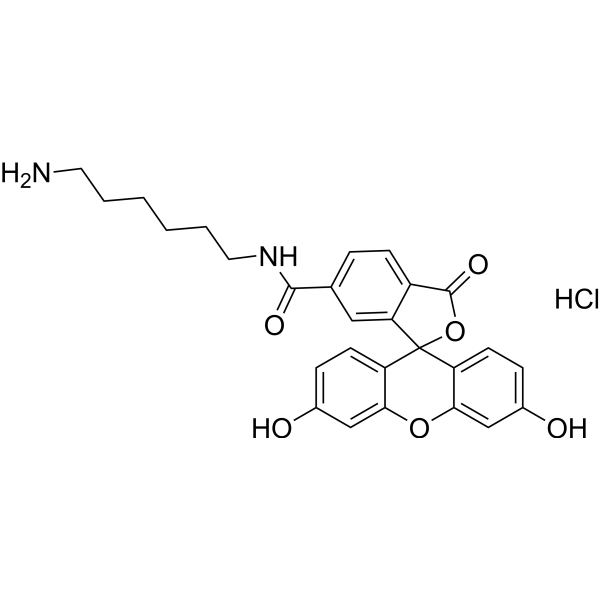
FAM amine, 6-isomer is a fluorescein derivative with an amine group and contains an isomer of the fluorophore. Can be used to modify biomolecules through enzymatic transamination. Its fatty amine groups can also react with electrophiles such as activated esters. The amine can also be conjugated to carbonyl compounds (aldehydes and ketones) by reductive amination.
loading...
    loading...
Cat. No.: HY-114351
CAS No.: 178388-71-1
Purity:  97.40%
Target:  

Fluorescent Dye

Research Areas:  

Others

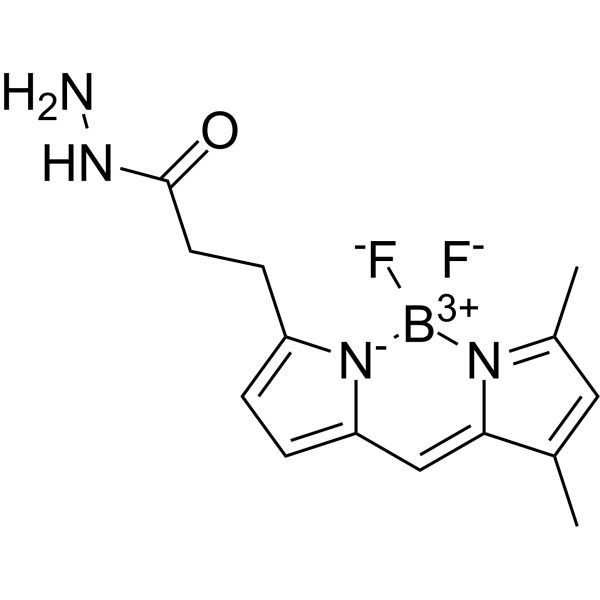
BODIPY FL hydrazide is a BODIPY-containing hydrazide fluorescent dye. BODIPY FL hydrazide is used to label carbonyl groups on oxidatively damaged proteins, 3-ketosteroids, and heparin/heparan sulfate carbohydrates. BODIPY FL hydrazide specifically binds to protein carbonyls, steroid keto groups, or reducing-end carbonyls of carbohydrates through derivatization or reductive amination via its hydrazide group to form stable conjugates; after the reaction is complete, the labeled molecules emit strong fluorescence (Ex/Em = 488-495/516-520 nm) .
loading...
    loading...
Cat. No.: HY-D0099
CAS No.: 76863-28-0
Target:  

Fluorescent Dye

Research Areas:  

Others

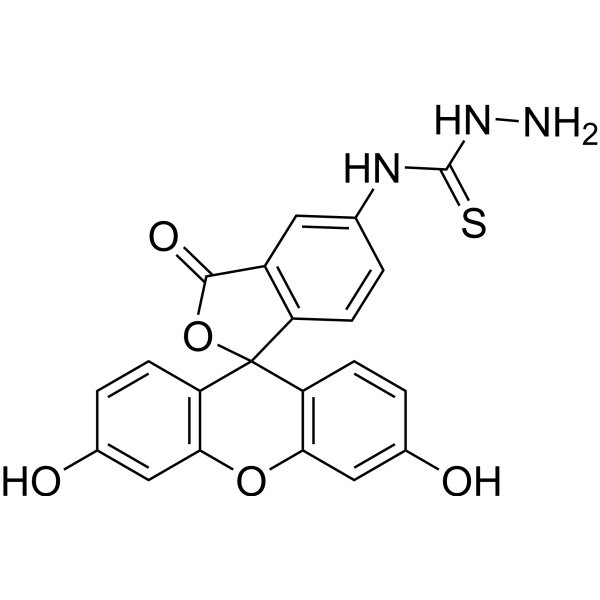
Fluorescein-5-thiosemicarbazide is a green fluorescent probe used for carbonyl labeling. The thiosemicarbazide group of FTSC reacts with aldehyde groups at the reducing ends of carbohydrates via reductive amination, and can also undergo chemoselective ligation with ketone groups in systems such as 2-keto Ac4GalNAc to form stable fluorescent derivatives. FTSC is applicable for fluorescent labeling of carbohydrates and enables fluorescence imaging of mucin-type O-linked glycoproteins in the 2-keto Ac4GalNAc metabolic labeling system. Free FTSC exhibits Ex/Em = 495/517 nm in PBS. FTSC is suitable for carbohydrate labeling and cellular glycosylation imaging studies .
loading...
    loading...
Cat. No.: HY-P2768
CAS No.: 9082-71-7
Synonyms: LDH, EC 1.4.1.9
Research Areas:  

Metabolic Disease

Leucine dehydrogenase, Microorganism (EC 1.4.1.9) can be purified from Bacillus spheroides. Leucine dehydrogenase catalyzed the oxidative deamination of L-leucine, L-valine, L-isoleucine, L-norvaline, L-alpha-aminobutyrate, and L-norleucine, and the reductive amination of their keto analogues .
loading...
    loading...
Cat. No.: HY-W002925
CAS No.: 213697-53-1
Target:  

Drug Intermediate

Research Areas:  

Others

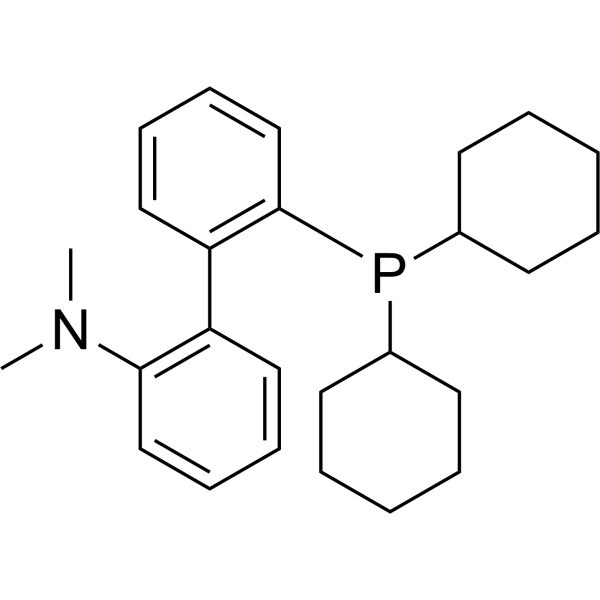
DavePhos is a phosphine ligand and electron donor. DavePhos can form cationic rhodium complexes to promote the selective hydrocarboxylation of styrene derivatives with CO2 and H2. As a sacrificial electron donor, DavePhos assists in generating active Rh-H species to initiate the catalytic cycle. DavePhos can be used in Buchwald−Hartwig cross-coupling reactions within palladium-based catalytic systems. DavePhos is applicable to platinum-catalyzed reductive amination of amine-acid .
loading...
    loading...
Cat. No.: HY-W099634
CAS No.: 540-08-9
Synonyms: Heptadecan-9-one
Research Areas:  

Others

9-Heptadecanone (Heptadecan-9-one) is an aliphatic molecule with a central ketone on a C17 chain. The ketone may react with amines in reductive aminations to link this molecule to larger lipid structures.
loading...
    loading...
Cat. No.: HY-W451211
CAS No.: 1447701-63-4
Target:  

Ligands for E3 Ligase

Research Areas:  

Cancer

Thalidomide-5-carbaldehyde is a Thalidomide analogue with an aldehyde. Thalidomide recruiits E3 ligase for the ubiquitinylation and subsequent proteolysis of target proteins. The aldehyde is highly reactive towards amine nucleophiles through reductive amination among other reactions.
loading...
    loading...
Cat. No.: HY-W586329
CAS No.: 2369068-46-0
Target:  

Ligands for E3 Ligase

Research Areas:  

Others

Thalidomide-4-carbaldehyde is a Thalidomide analogue with an aldehyde. Thalidomide recruiits E3 ligase for the ubiquitinylation and subsequent proteolysis of target proteins. The aldehyde is highly reactive towards amine nucleophiles through reductive amination among other reactions.
loading...
    loading...
Cat. No.: HY-W010685
CAS No.: 79255-71-3
Synonyms: [Rh(dppb)(COD)]BF4
Research Areas:  

Others

[1,4-Bis(diphenylphosphino)butane](1,5-cyclooctadiene)rhodium(I) tetrafluoroborate ([Rh(dppb)(COD)]BF4) serves as a rhodium-based catalyst that facilitates regioselective hydrogenation and enantioselective reductive amination reactions.
loading...
    loading...
Cat. No.: HY-W800837
CAS No.: 2231240-82-5
Target:  

ADC Linkers

Research Areas:  

Cancer

t-Boc-N-amido-PEG4-Val-Cit is a protease-cleavable ADC linker featuring a Boc-protected amine, a hydrophilic PEG spacer, and a Val-Cit dipeptide. The Val-Cit dipeptide is cleavable by cell proteases and features a carboxylic acid which is free for coupling reactions with amines to form amides. The Boc can be removed under acidic conditions to reveal a free primary amine, which may be used in a variety of reactions such as coupling or reductive amination.
loading...
    loading...
Cat. No.: HY-D1332
CAS No.: 2183473-45-0
Target:  

Fluorescent Dye

Research Areas:  

Others

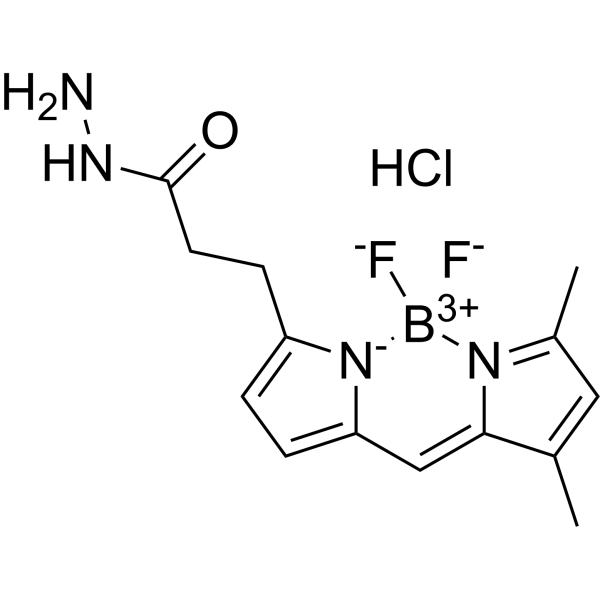
BODIPY FL hydrazide hydrochloride is a BODIPY-containing hydrazide fluorescent dye. BODIPY FL hydrazide hydrochloride is used to label carbonyl groups on oxidatively damaged proteins, 3-ketosteroids, and heparin/heparan sulfate carbohydrates. BODIPY FL hydrazide hydrochloride specifically binds to protein carbonyls, steroid keto groups, or reducing-end carbonyls of carbohydrates through derivatization or reductive amination via its hydrazide group to form stable conjugates; after the reaction is complete, the labeled molecules emit strong fluorescence (Ex/Em = 488-495/516-520 nm) .
loading...
    loading...
Cat. No.: HY-W800619
CAS No.: 2055024-61-6
Target:  

ADC Linkers

Research Areas:  

Others

NH2-PEG4-Val-Cit-PAB-OH is a cleavable ADC linker featuring a primary amine, a hydrophilic PEG spacer, a Val-Cit dipeptide, and a PAB group. The benzylic alcohol on the PAB can be used to attach with reactive groups such as PNP for conjugation with drug payloads. The primary amine is free to perform a wide variety of reactions such as coupling with carboxylic acids, reductive aminations with ketones or aldehydes, or other more specialized uses such as in SNAr reactions or heterocyclic chemistry. The Val-Cit dipeptide is cleaved by cellular proteases within the cell to allow for efficient payload delivery via an elimination mechanism within the PAB structure.
loading...
    loading...
Cat. No.: HY-W800617
CAS No.: 2055024-63-8
Target:  

ADC Linkers

Research Areas:  

Cancer

NH2-PEG1-Val-Cit-PAB-OH is a cleavable ADC linker intermediate featuring a primary amine, a hydrophilic PEG spacer, a Val-Cit dipeptide, and a PAB group. The benzylic alcohol on the PAB can be used to attach with reactive groups such as PNP for conjugation with drug payloads. The primary amine is free to perform a wide variety of reactions such as coupling with carboxylic acids, reductive aminations with ketones or aldehydes, or other more specialized uses such as in SNAr reactions or heterocyclic chemistry. The Val-Cit dipeptide is cleaved by cellular proteases within the cell to allow for efficient payload delivery via an elimination mechanism within the PAB structure.
loading...
    loading...
Cat. No.: HY-W800618
CAS No.: 2055024-62-7
Target:  

ADC Linkers

Research Areas:  

Others

NH2-PEG3-Val-Cit-PAB-OH is a cleavable ADC linker featuring a primary amine, a hydrophilic PEG spacer, a Val-Cit dipeptide, and a PAB group. The benzylic alcohol on the PAB can be used to attach with reactive groups such as PNP for conjugation with drug payloads. The primary amine is free to perform a wide variety of reactions such as coupling with carboxylic acids, reductive aminations with ketones or aldehydes, or other more specialized uses such as in SNAr reactions or heterocyclic chemistry. The Val-Cit dipeptide is cleaved by cellular proteases within the cell to allow for efficient payload delivery via an elimination mechanism within the PAB structure.
loading...
    loading...
Cat. No.: HY-W800620
CAS No.: 2055024-60-5
Target:  

ADC Linkers

Research Areas:  

Others

NH2-PEG6-Val-Cit-PAB-OH is a cleavable ADC linker featuring a primary amine, a hydrophilic PEG spacer, a Val-Cit dipeptide, and a PAB group. The benzylic alcohol on the PAB can be used to attach with reactive groups such as PNP for conjugation with drug payloads. The primary amine is free to perform a wide variety of reactions such as coupling with carboxylic acids, reductive aminations with ketones or aldehydes, or other more specialized uses such as in SNAr reactions or heterocyclic chemistry. The Val-Cit dipeptide is cleaved by cellular proteases within the cell to allow for efficient payload delivery via an elimination mechanism within the PAB structure.
loading...
    loading...
Cat. No.: HY-W800833
CAS No.: 55946-27-5
Research Areas:  

Others

Benzyl N-[2-(prop-2-enamido)ethyl]carbamate is a short aliphatic linker featuring a Cbz-protected amine and an acrylamide. Acrylamide is a Michael acceptor which is a good Michael acceptor which can be used in thiol-based bioconjugation or polymerization. Meanwhile, the Cbz protecting group can be removed using Pd-C hydrogenation to reveal a free amine that can participate in a wide variety of reactions such as couplings or reductive amination.
loading...
    loading...
  • 1