8 Results for "

keto reduction

" in MedChemExpress (MCE) Product Catalog:
Products (8)

8 Results for "keto reduction" in MCE Product Catalog:

Cat. No.: HY-D0099
CAS No.: 76863-28-0
Target:  

Fluorescent Dye

Research Areas:  

Others

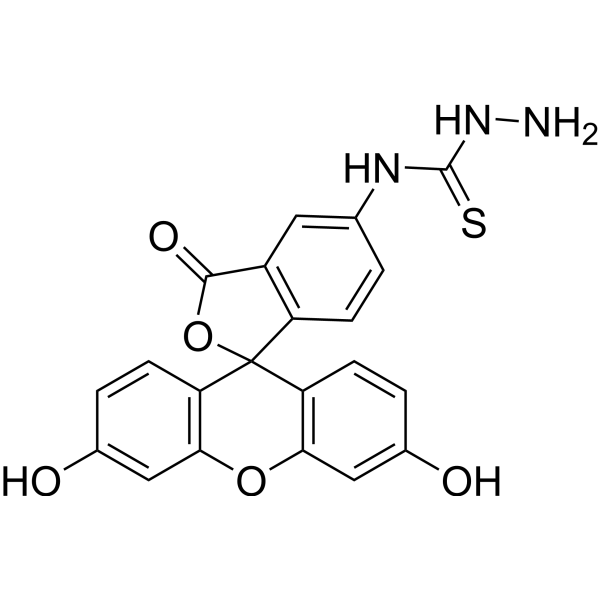
Fluorescein-5-thiosemicarbazide is a green fluorescent probe used for carbonyl labeling. The thiosemicarbazide group of FTSC reacts with aldehyde groups at the reducing ends of carbohydrates via reductive amination, and can also undergo chemoselective ligation with ketone groups in systems such as 2-keto Ac4GalNAc to form stable fluorescent derivatives. FTSC is applicable for fluorescent labeling of carbohydrates and enables fluorescence imaging of mucin-type O-linked glycoproteins in the 2-keto Ac4GalNAc metabolic labeling system. Free FTSC exhibits Ex/Em = 495/517 nm in PBS. FTSC is suitable for carbohydrate labeling and cellular glycosylation imaging studies .
loading...
    loading...
Cat. No.: HY-114351
CAS No.: 178388-71-1
Purity:  97.40%
Target:  

Fluorescent Dye

Research Areas:  

Others

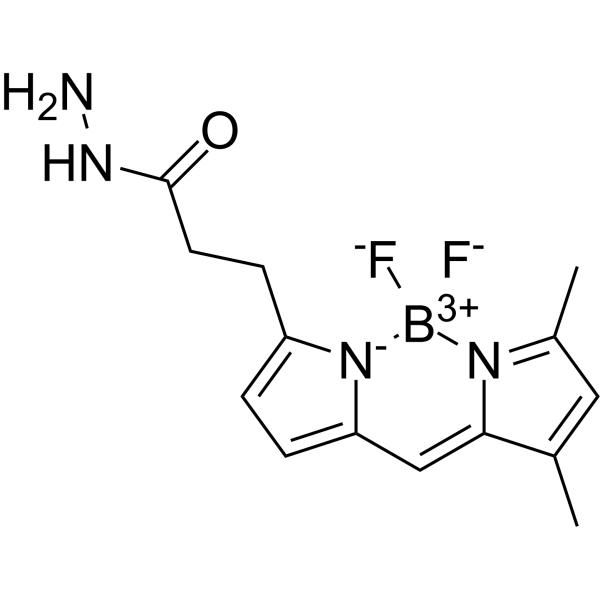
BODIPY FL hydrazide is a BODIPY-containing hydrazide fluorescent dye. BODIPY FL hydrazide is used to label carbonyl groups on oxidatively damaged proteins, 3-ketosteroids, and heparin/heparan sulfate carbohydrates. BODIPY FL hydrazide specifically binds to protein carbonyls, steroid keto groups, or reducing-end carbonyls of carbohydrates through derivatization or reductive amination via its hydrazide group to form stable conjugates; after the reaction is complete, the labeled molecules emit strong fluorescence (Ex/Em = 488-495/516-520 nm) .
loading...
    loading...
Cat. No.: HY-P2768
CAS No.: 9082-71-7
Synonyms: LDH, EC 1.4.1.9
Research Areas:  

Metabolic Disease

Leucine dehydrogenase, Microorganism (EC 1.4.1.9) can be purified from Bacillus spheroides. Leucine dehydrogenase catalyzed the oxidative deamination of L-leucine, L-valine, L-isoleucine, L-norvaline, L-alpha-aminobutyrate, and L-norleucine, and the reductive amination of their keto analogues .
loading...
    loading...
Cat. No.: HY-116170
CAS No.: 1548116-54-6
Target:  

17β-HSD

Research Areas:  

Cancer

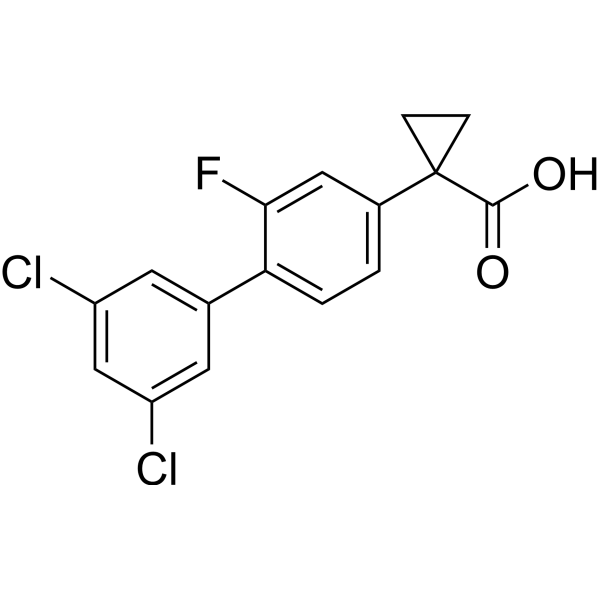
SN34037 is a specific inhibitor of Aldo-keto reductase 1C3 (AKR1C3, EC 1.1.1.188) with the ability to inhibit the cytotoxic activity of PR-104A. SN34037-sensitive coumberone reduction provides a rapid and specific assay for AKR1C3 activity. SN34037 inhibits the aerobic cytotoxicity of PR-104A in TF1 erythroleukemia cells with high AKR1C3 expression, but not in Nalm6 pre-B acute lymphoblastic leukemia cells with low AKR1C3 expression .
loading...
    loading...
Cat. No.: HY-W021016
CAS No.: 824395-67-7
Synonyms: (S,S)-Ph-BPE
Research Areas:  

Others

(+)-1,2-Bis ((2S,5S)-2,5-diphenylphospholano)ethane ((S,S)-Ph-BPE) is a chiral bisphosphine ligand and catalyst. (+)-1,2-Bis ((2S,5S)-2,5-diphenylphospholano)ethane acts as a chiral ligand in rhodium-catalyzed reductive hydroformylation of alkenyl boronic esters, enabling enantiodivergent synthesis of chiral γ-boryl alcohols. (+)-1,2-Bis ((2S,5S)-2,5-diphenylphospholano)ethane forms chiral nickel-phosphine complexes to mediate asymmetric hydrogenation of aliphatic γ- and δ-keto acids; protons promote substrate C=O bond activation and stereoselectivity control via hydrogen bonding. (+)-1,2-Bis ((2S,5S)-2,5-diphenylphospholano)ethane forms a monodentate nickel complex, which serves as the active species for asymmetric hydrogenation of aliphatic keto acids .
loading...
    loading...
Cat. No.: HY-116889
CAS No.: 369585-22-8
Target:  

Drug Metabolite

Research Areas:  

Others

15-keto Latanoprost is a potential metabolite of latanoprost (HY-B0577) when administered to animals. 15-keto Latanoprost is also one of the common minor impurities found in commercial preparations of the bulk drug compound. Although much less potent that the parent compound latanoprost, 15-keto latanoprost still retains the ability to produce a small but measurable decrease (1 mm Hg) in the intraocular pressure of normal cynomolgus monkeys when administered at a dose of 1 μg/eye.1 15-keto Latanoprost is also a miotic in the normal cat eye, causing an 8 mm Hg reduction in pupillary diameter at 5 μg/eye. Again, this is not as potent as many other F-type prostaglandins; for example, prostaglandin F2α will produce this degree of miosis at a dose of less than 1 μg/eye.
loading...
    loading...
Cat. No.: HY-155035
CAS No.: 876625-29-5
Purity:  99.48%
Research Areas:  

Cancer

S07-1066 is an aldo-keto reductase 1C3 (AKR1C3) inhibitor, synergizing doxorubicin (DOX) cytotoxicity. S07-1066 selectively blocks AKR1C3-mediated reduction of DOX, and reverses the DOX resistance in overexpressing AKR1C3 cells .
loading...
    loading...
Cat. No.: HY-D1332
CAS No.: 2183473-45-0
Target:  

Fluorescent Dye

Research Areas:  

Others

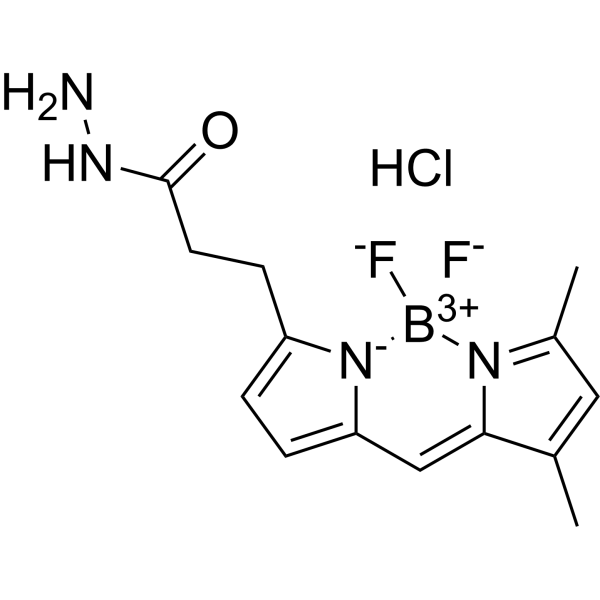
BODIPY FL hydrazide hydrochloride is a BODIPY-containing hydrazide fluorescent dye. BODIPY FL hydrazide hydrochloride is used to label carbonyl groups on oxidatively damaged proteins, 3-ketosteroids, and heparin/heparan sulfate carbohydrates. BODIPY FL hydrazide hydrochloride specifically binds to protein carbonyls, steroid keto groups, or reducing-end carbonyls of carbohydrates through derivatization or reductive amination via its hydrazide group to form stable conjugates; after the reaction is complete, the labeled molecules emit strong fluorescence (Ex/Em = 488-495/516-520 nm) .
loading...
    loading...

